Pear productivity

Last month, Alexandra Needham commented on a post of mine suggesting a way to get more productive 25 minutes at a time.
pear timer


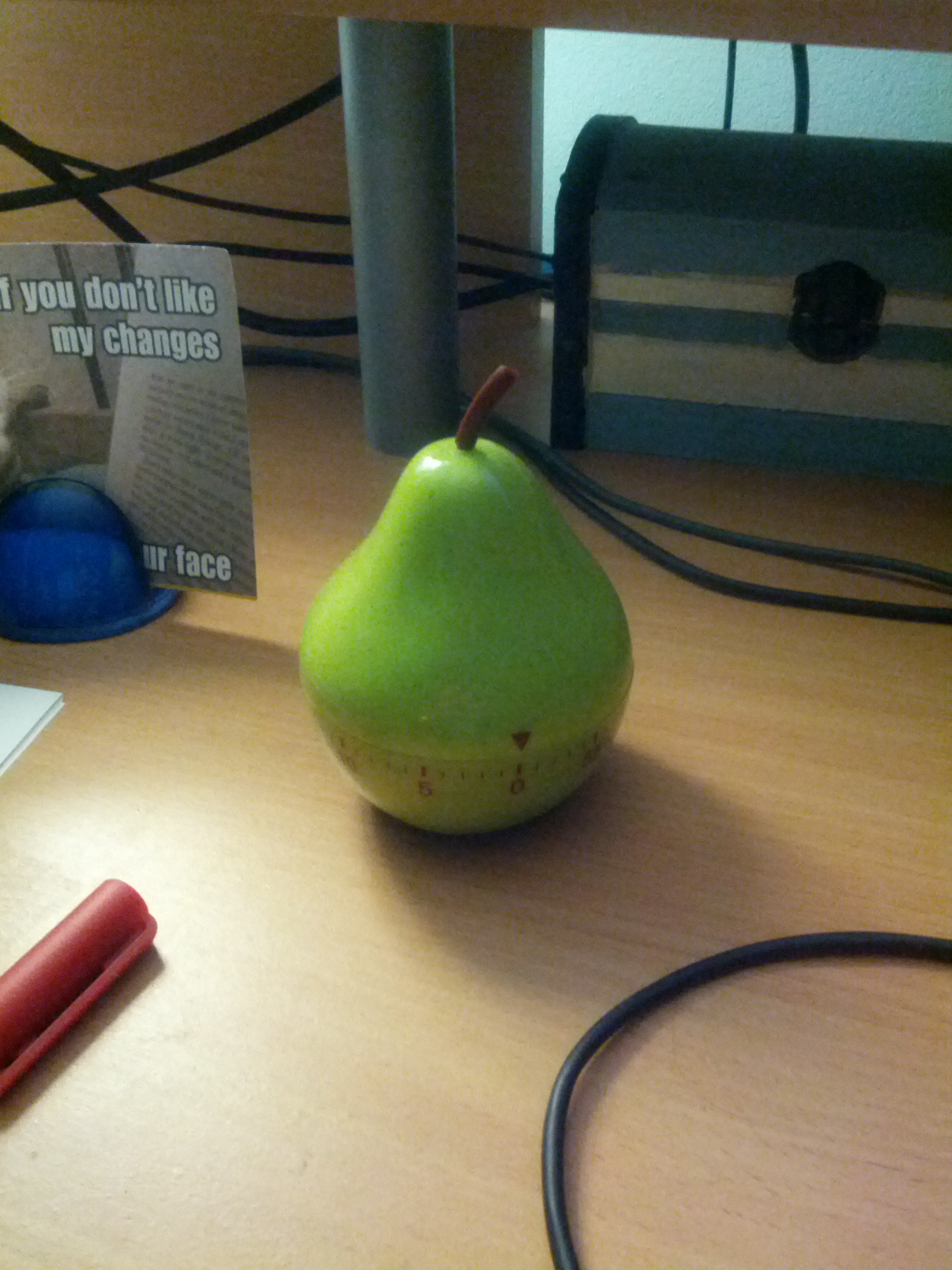
While shopping at the dollar store yesterday, I snagged this pear-shaped timer. After attempting to scare my cats with it (they were unfazed), I set it on my desk and planned to use it to boost my own productivity. That isn’t to say that I haven’t been productive lately; I got over 4,500 words out over the course of the last week. I also wrote in my personal journal, reminding myself that no matter how much faster I am at the keys, there is something special about seeing a page covered in my hurried scrawl. When I write longhand, I feel like I’m always in a race to get the thoughts out before I forget them.

I would like to try writing daily for 25 uninterrupted minutes as an exercise. If at the end of that time I still feel inspired, I will let that momentum push me forward and write more. While the pear is ticking, I will refrain from looking up definitions or points of research; the details can be sorted out later. I’ve already disabled spellcheck in Scrivener since I can’t force myself to ignore those squiggly red lines as I write. Typos be damned, proofreading is part of the editing process anyway, so I won’t let it interfere with this step.

I am on vacation again, so it seems like the perfect opportunity to form new habits.

Another thing I’d like to do this week is flesh out the page for Project: Destiny, which is currently pretty sad.

Then Bravely Default will come out Friday and my productivity will go down the toilet…
Religion of Destiny

I’m getting back into the swing of writing on Destiny, which is fun and something like visiting an old friend (albeit a friend whose details I can change if I like). Older drafts have begun with Sehra waiting outside a house on the cliffs, something I’ve needed to change because what mother leaves her eight-year-old daughter to play with the edge of high cliffs nearby? This new draft begins with the death of Sehra’s father, the event that drives her mother to seek the aid of the witch atop the cliffs. This time, Sehra will be invited into the house instead of left to play with seashells.

One thing moving back has afforded me is a chance to introduce the dominant religion of the region in which Destiny mostly takes place. Two fisherman burst into a church, holding a third between them; the third fisherman is unconscious and in grave peril. His comrades bring him to the church to seek the aid of nuns, who are skilled in the healing arts. Also, a church is an apt location to pray for the health of a wounded friend.

I enjoy making up religions, taking elements from this one and that one to create an interesting set of deities and clergymen. There is the Church of the Sun, whose followers worship Destiny and Her Daughters and call themselves Followers of the Path. They believe that those who study and use “magic” are servants of Fate, the Unraveler. Magic-users, on the other hand, believe the universe was created by the Shaper, who bound the Oathbreaker and created six other deities to govern various aspects of reality. However, magic-users do not usually worship the deities of their paradigm.

“Honeycakes!” Sehra gushed, reaching out for one. Her mother pulled them away.

“What do we say before we eat?”

The girl grunted in frustration, then put both hands together and closed her eyes. “Our thanks to you, Destiny, for this bounty. Bless this food and all those who share it. Bless it by sea, sky and stone, as you have blessed me. By the Three, so let it be.”

“So let it be,” Donja repeated, smiling. Sehra grabbed a cake from the top of the pile and bit into its sticky sweetness with relish.

So here we have a bit of prayer, like saying grace before meals, that would be lacking from a magic-user’s routine. The Church of the Sun has ceremony and tradition, while the other has the practice of magic.

Destiny is begun

I’ve decided to give Destiny a go while I’m working on editing Climbing Yggdrasil. I got over 1,000 words out in the first sitting and am itching to get back to it. I made a realization yesterday, that I am hesitant to do any writing if I’m not sitting in front of my computer. There’s nothing stopping me from writing in a notebook or on the back of an envelope and typing it into Scrivener as soon as I can. I might even do a bit of editing or rearranging as I’m transferring from paper to computer.

I’ve built up all these mental blocks in my head about writing, it seems. “No, I can’t do that.” Why the hell not?

“You would have your husband tainted by the Unraveler’s power? You would make yourself a slave to one of his minions?”

“Anything to keep him with me.”

Brother Horas shook his head. “My child,” he said, “all Paths come to an end. If Destiny wills–”

“Fate is the one who ends the Path,” Donja interjected.

Early mornings, thinking on Destiny

My experiment in waking up early terminated rather abruptly when the lack of sleep caught up with me by Wednesday evening. I left my alarm where it was, but on its first sounding I pushed it back to my usual time and happily slept another hour. Thursday evening, I didn’t even bother; I set the clock straightaway to the later time.

Three mornings out of five isn’t too bad, right? I’m left unsure of what I’ll do this coming week, though. It was nice, it felt good to have more time to wake up before stepping out into the cold. One morning had me sleeping in the métro, head bobbing as the tunnels curved left and right. This leaves me getting to work feeling groggy and unfocused, nullifying the peaceful hour I spent in front of my computer.

There is also the fact that I am not doing much writing these days making it more attractive to stay in bed for that extra hour. I have it set in my head that I must devote all of my attention to Yggdrasil before setting off on another project. Every now and then, though, I wonder: can’t I do both? It’s like when I hop back and forth between two books that I’m reading; as long as they aren’t too similar, I don’t run the risk of confusing characters and events.

I worry about one project sweeping me too far away from another, though. If some grand inspiration should strike, I would be foolish to ignore it by saying, “No, I have to work on the other project now to be fair.”

I keep forgetting that what I should do is try new things and change tactics if they don’t work. There is no manual for this, no way to find out what works for me without first attempting it. A story left behind does not curl up and die, either; worst case, the words will sit there patiently for my return, like the myriad ideas I’ve scribbled down and left to gather dust. Perhaps they even ripen in my absence, growing fuller and more interesting.

I think I’ll go play in Destiny a bit to see where my head’s at.

Realistic fantasy, colors with substance

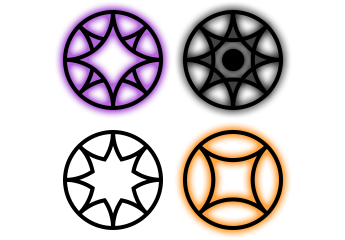
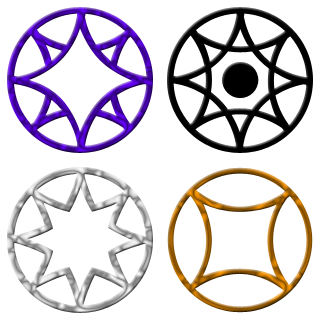
Having written on duality, especially that of creation and destruction, I’m thinking of elements in my oldest project. If you look at my blog’s header, you’ll notice the following four symbols:

fourprincipals

I have these tattooed on my inner right forearm; they represent four principal deities in Project: Destiny, and also the four domains of magic they govern. The symbols don’t derive any meaning from their shape. They are all manipulations of the orange symbol, the oldest and simplest of them.

Violet represents the duality of creation and destruction. In Project: Destiny, it also is the domain of reality and its boundaries.

Next is black, the color of chaos, secrets and lies. It also represents the future, as entropy dictates that order must descend into chaos; and thus mortality and death.

In opposition, white is the color of order, knowledge and truth; as well as the past. Black and white do not represent good and evil, however. Both lies and truth can be used to either end, as can chaos and order.

Orange is a special color in the world of Destiny. It represents many things, primarily oaths. In the world of Destiny, people are taught to never swear an oath to someone they cannot trust with their lives, as skilled “wizards” can use their power to bind the unwary to fulfill such an oath. Orange also represents language, blood ties, and humanity. This is in opposition to violet, whose power over creation and destruction can be compared to the power of gods.

Four other symbols complete this set, and these are tattooed on my left forearm: one for each of the classical elements of water, fire, earth and air. Together, these make up the eight colors of magic as portrayed in Project: Destiny.

I find it very important that magic have limits. If a character is backed up against the wall only to cast some kind of spell as a last resort, it needs to be realistic enough to be anticipated by the observant reader. If magical folk can spell their way out of any unpleasant circumstance by bending the laws of nature, they quickly become irritating. For this reason, I spend a lot of time on the way magic works in my fantasy projects. What does it cost the user? What can it do? How can it be beaten? When is it not worth the effort?

I feel like a learned a long time ago that for it to be worth the read, fantasy has to be realistic. The best-defined magic system can make all the sense in the world, and no one will give a damn if the characters aren’t interesting or don’t do anything worth reading about. Otherwise it’s all pretty colors without any substance underneath.

Chapters and scenes

While I was writing Climbing Yggdrasil, I outlined chapters in Scrivener by writing a brief summary and filling in the narrative from that alone. However, the default in Scrivener seems to be filling a chapter with scenes, which I had not considered before.

I finished the broad strokes of the outline for Destiny and thought I could give scenes a shot. It’s sort of like going from mile markers to smaller signs every tenth of a mile. There’s a little voice in my head saying that this will just give me more opportunities to deviate from the outline; I think I get some of my best ideas that way.

For this story, I don’t want to simply outline a sequence of events. I want to write notes about what’s going on inside the characters’ heads, thoughts and feelings that I can allude to through well-placed expressions and subtle behaviors. Yggdrasil was something of a race, with all the pressure of NaNoWriMo, but now I can take the time to get more right on the first attempt. If the characters’ thoughts and desires come through in a suitably subtle way in the first draft, that leaves less for me to polish during the editing process. (By “subtle” here, I mean that I’m not beating the reader over the head with what the character is feeling; some characters, like some people, clearly display every emotion they feel on their face with no subtlety whatsoever.)

I feel like my biggest obstacle with Destiny will be parceling out information properly. I want to tantalize without frustrating the reader. I want to explain without lecturing. Above all, I want to be economic with my explanations. No one wants to read a book where the main character takes up pages and pages of every chapter expounding on the way the world works. It would be far more effective to set up scenarios in which the reader can directly witness forces at work and come up with their own conclusions.

Here’s to hoping that in going deeper and outlining scenes for the story that I discover new ideas and better ways to write it. Something I have to keep reminding myself of is that nothing is set in stone, not even if I stated it in an outline or the rough draft or a later draft. Until a book is published, I can rearrange and change anything that doesn’t work for me. The worst case is that I have to rewrite something and it takes a little more time; a small enough price for getting it right.

January for planning

One of the best ways to set a project aside for a time is to move on to a new one, right? I have begun outlining Project: Destiny, a fantasy story which is one of my oldest ideas. General advice suggested not to bring my baby to NaNoWriMo, so I opted for something newer then. Now that I’ve finished that project, it’s time to return to my roots.

I find that the self-imposed deadline works pretty well for me in lieu of actual deadlines, so I am giving myself until the end of January to outline the story in its entirety. One month seems like plenty of time, and then I’m also giving myself a nice stopping point. Perhaps once a month has passed, I will be ready to set my completed outline aside and return to Climbing Yggdrasil for editing.

In the days leading up to NaNoWriMo, I created a fairly ramshackle outline and ended up adding a fair amount to the beginning and even more to the end. This time around, I want an entire story outlined from start to finish. A nice, solid road to walk on with signs and everything. Naturally, I will find the occasional dirt path leading off to more interesting vistas, and I won’t let prior planning get in the way of these deviations. If a story is willing to take me places, I have to let it if I want to see if those places are any good.

Climbing Yggdrasil features very few points of view. The bulk of the story is told from the third person, from the captain’s POV. This occasionally shifts to other crewmembers from time to time when circumstances force them to split up, but we aren’t regularly in another character’s head. The exception is the synchronizer, who gets a short POV chapter every few chapters or so, told from the first person.

destiny outline

Destiny is different in that it has a larger cast of characters in different geographical locations, so the POV shifts more regularly than it did in Yggdrasil. For this reason, I’m taking advantage of Scrivener’s ability to color code index cards in the corkboard view; each major POV character gets their own color so that it’s easy for me to see if I’ve ignored one of them for too long. I also want to revisit the Scrivener tutorial to see if there are other tools I didn’t use in Yggdrasil that might serve me well in Destiny. There is a lot more history in this story, a lot more notes on the way things work from government to magic. I haven’t been idle all these years, I’ve built up quite a skeleton for this story. Now I have to put some meat on the bones.