Mystery or explanation?

A central entity in Project: OBSIDIAN is SEEC, the Corporation that rules the Yggdrasil System in place of government. How the planets came to be ruled by a corporation is never explained within the story, and neither is the meaning of the acronym “SEEC”. It was a decision I made early on that I’m now questioning: the company is only ever referred to as SEEC or the Corporation so far.

On the side of mystery, we have the fact that the company has its own interests closest to heart. This leads them to keep many of their activities hidden for fear of evoking outrage in the people. Their true name would just be another thing to hide; though not necessarily incriminating, the executives of the Corporation may have come to enjoy this part of the mystique.

On the side of transparency, SEEC nominally exists to serve the people. They have provided the organization that allows the planets to best work together, the security that keeps most spacecraft safe from attacks by pirates, and advances in medical technology to prolong the lives of the people. Their name is a bone they can easily throw to the populace in the name of transparency.

Then again, perhaps the name was once well-known in the early years of the Corporation, but has now faded into obscurity like that of Nabisco; some people know what it is, but most can’t be bothered to care.

I’m interested in hearing some opinions on the matter. Please let me know what you think in the comments.

Still climbing

I’m still climbing, slowly but surely, getting higher and higher. I have 302 printed manuscript pages and at least three chapters I haven’t even started. I’ve broken 61,000 words.

“Once upon a time, there was a young girl who lived with her parents in a city made of grey. They didn’t always have enough to eat, and they were often cold, but they loved each other very much and laughed all the time. One day, the girl’s father went off to work but never came home.”

“What happened to him?” Estelle asked.

“There was an accident at the factory,” Kandace said in a whisper. She continued, “The girl’s mother was so sad, she cried and cried. The girl didn’t understand, not why her father wasn’t coming home, not why her mother wouldn’t laugh anymore. The girl began to get sad and look up to the sun.”

“The sun?”

“A great, burning light in the sky,” Kandace explained. “It’s name is Yggdrasil, and in stories it is a giant tree made of fire. The girl liked to watch the sun, imagining it as the giant tree, imagining that she would climb its branches to another world.

“Then, her mother got sick. The girl thought it was because of the sadness inside her. She thought it turned to poison and made her mother sleepy, so sleepy, until she didn’t wake up anymore.

“Without her mother and father to care for her, the girl started to plan a journey. She would take only the most essential things, pack them in a bag, and climb the burning tree to the stars. She climbed and climbed, stopping at each world she found, but learning that she preferred to climb from world to world than ever stop.”

A queer thing about characters

As a gay reader, I find that there are disappointingly few examples of surprise gay characters in the fiction I’ve read. What I mean is that I’d love to read about a secondary character who just so happens to fancy the same sex. The story doesn’t revolve around it, but it’s there.

Naturally, I feel like I can write differently. But I want it to be as subtle and as insignificant to the plot as that character’s eye color; a detail and not a defining feature. Not a woman who is introduced as a lover of women, but one we get to know for her other quirks and charms before learning, “Oh, by the way…” Because I want readers to see the person, not the sexuality.

I feel this way about all other aspects of a person that people find sorry excuses to discriminate against: gender, race, socioeconomic background, etc. If one of my characters is disliked, let it be because he’s an asshole, or she beats children. Not because he likes men or she’s a woman.

There are a few characters in my current story who do not identify as heterosexual. It hasn’t come up in the narrative, though I’ve left subtle hints here and there. I may not end up explicitly stating it, but they’re there. As long as it’s not relevant to the plot, there’s no real reason to come out and say it.

As in anything else, I reserve the right to change my mind. It would be fun to write a coming out scene where a character makes a heartfelt declaration and those closest to him respond with, “We know, dear.” I have one in mind who would fit perfectly into such a moment.

To summarize, I want more gay folk in fiction and I’m doing my part to make that happen. These characters will be realistic, well-rounded and flawed. They will be everything a good character should be, plus fabulous.

December so far

obsidian word count december

It’s a little disheartening to see how long it’s taken me to write another 10,000 words since the end of NaNoWriMo, but I just have to remind myself that I’m still doing far better than I was before November.

What is Project: OBSIDIAN?

I have made mention of Project: OBSIDIAN a few times already without going into proper detail as to what it is. I had written a couple chapters of it before November of this year, which I set aside to do NaNoWriMo properly. As of now, I have nearly 60,000 words and only a few chapters left to write to finish my first draft. It is the story of Captain Kandace Li Renwright of the starship Sylphid, who begins the book resisting her crew’s efforts to change her mind about getting a synchronizer for the ship, a device that would allow the ship to maintain a constant connection to the interplanetary network no matter where they traveled. The following is an excerpt from my rough draft:

Yet Kandace continually refused, for she knew what a synchronizer was.

In a “humane effort” to eliminate the death penalty for particularly heinous crimes, the sentence of synchronization came about. The conversion process remained a tightly held secret, though it was suggested that it involved heavy amounts of psychopharmaceutical injected into the sentenced. It was said that their mind became too fragmented for conscious thought, essentially vegetables floating in a vat of nutrients, but their splintered mind became capable of sharing information with other similar minds, across amazing distances. Attached to a rig to convert biochemical signals to computer language and back, they found practical use as devices to extend the SEEC Central Network onto ships no matter how far they traveled.

Kandace had no intention of having such a person aboard her ship, no matter how much they deserved such a fate. She found the very idea disgusting, and wondered what a synchronizer was aware of. Did they experience constant, unconscious confusion as their brains were bombarded by computer signals relayed back and forth psychically? Did they dream, their minds desperately attempting to cobble together some kind of experience from the data downloaded and uploaded through them? Did it hurt?

Naturally, there wouldn’t be much of a story if she didn’t get to discover the answers to some of her questions. Before long, Kandace relents and procures a synchronizer for her ship, one who will reveal himself to be aware of all the information that passes through his mind, capable of manipulating it, and intent on finding out who he used to be before he was made into a sync.

Fears about projects

Almost everything I have written was intended to eventually become a book. Yet when I used to refer to my writing, I would always call it a story or a project because I didn’t think I was serious enough to say, “I’m writing a book.” As though somehow, my dream of being published prevented me from calling anything I was working on a book, because a book isn’t really a book if it’s unpublished, right?

Now I’ve come to understand how that’s crap, how belittling my own work can lead to me taking it less seriously. There’s plenty of people in the world who will want to knock me down, I shouldn’t give them a head start by doing some of it myself.

I am a writer, because I write. Yes, I am unpublished, but I’m working on changing that. I am literally a few chapters away from finishing my first ever rough draft of a book. A real book with something like 300 pages. Perhaps I’ll soon discover that 300 manuscript pages is really tiny for a book, but during the mad rush of NaNoWriMo I found myself not having time to put in some things I meant to, little things like descriptions here and there, glimpses into characters’ pasts, and so on. During revision, I’ll get to find where best to insert those lost words.

I’ve never done serious revision of a long work before, and I am equal parts excited and afraid. I also feel relief when I think about NaNoWriMo’s “Now What?” months starting in January. They were so instrumental in keeping me motivated during November, so I hope it will be more of the same starting in the New Year.

Either way, 2013 is going to be the year I finished my first book. Rough draft of a book. Bah, semantics.

Introductions

This is my Yet Another Writing Blog, only this time in earnest (I swear!). I really ought to have started it back before November, but hindsight etc.

This is the year I decided to finally participate in the National Novel Writing Month, after years of giving myself excuses and saying it wasn’t serious enough for me, that I didn’t have the time, yada yada yada. How wrong I was. I barely scratched the surface of what NaNoWriMo has to offer; I dipped a toe into the forums and not much else.

The pep talks they sent out regularly were wonderful and made me feel like a writer again. I used to be so excited to come home from school, run upstairs and write for hours. I always had any number of projects going at once and my head bursting with ideas for them. Then I graduated, went to university, took a couple creative writing courses, and life got in the way. I didn’t make time for writing and I spent way too much time waiting for inspiration.

NaNo’s pep talks quickly divested me of the notion that inspiration exists and will flutter down and magically move me to put down an entire novel in record time. They taught me that I have to slog through it, most often when I don’t want to, if I want to get anywhere. Writing remains enjoyable, but it isn’t always, and I have learned to overcome those moments when I don’t know what to write next.

Now it’s December and I’m still slogging on, working to get the novel finished. 50,000 words was not enough to tell all of this story. My biggest problem so far with December was getting over the feeling of shame at not writing quite so much as I did in November. I’m still keeping track of my work count as a motivational tool, but it became demotivating as my average dropped to below 1,000 words per day. I managed to get past it by congratulating myself for having come so far already, and telling myself that 1,000 words a day beats my average for the past few years.

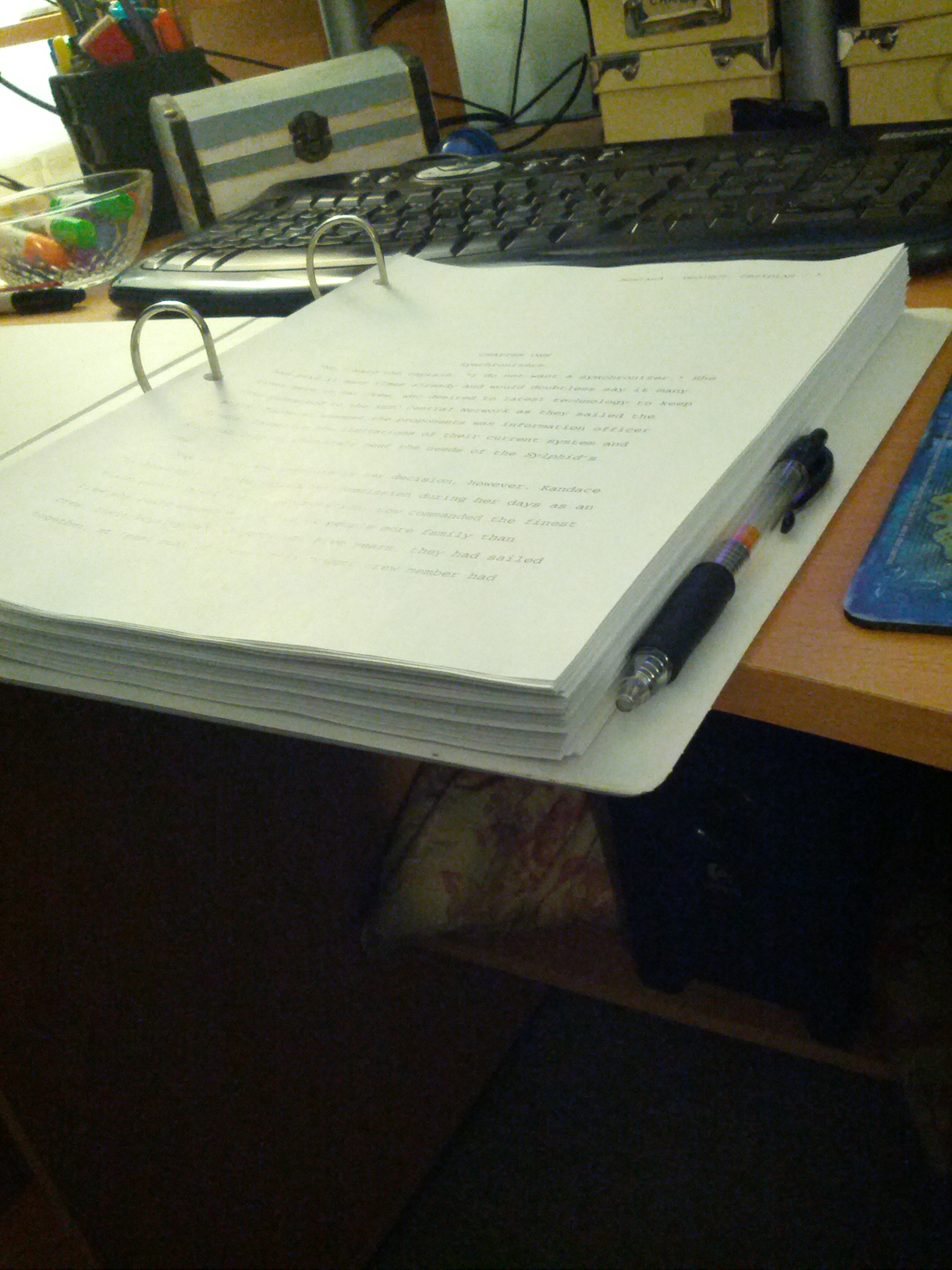
Lately, I’ve been printing out my novel a few chapters at a time, hoping to finish the first draft soon and begin editing. I haven’t made a decision yet as to whether I’ll set the work aside for a while before tackling Draft #2. I’d rather wait to see how I feel to see the whole thing printed out. This is what I’ve got so far, and it’s really awesome to see all of those pages sitting there. It’s roughly half the book, so knowing I’ll double that stack before I’m done is exciting.Image