The difference between talking and writing

Well, one’s talking, and one’s writing, right?

I feel like I have two internal voices: the one that gives words to my mouth, and the other that gives them to my pen (or keyboard). My speech voice has gotten all tangled up in recent years as I immerse myself more and more in the French language. Nowadays, I spend roughly 35 hours a week speaking almost exclusively French, and when I switch over to English I find remnants of that in my speech. The word “bien” is especially sticky, and it has no English equivalent in certain contexts. I also sometimes get mental blocks where I can’t think up the English word for something. “I’m going to have some toast with… wait… dammit… what’s the word for ‘confiture’?”

This used to upset me at first. I’ve been speaking English all my life, why should that get pushed out for French? I don’t actually think either of them has had to make room for the other, and I have enough bilingual people around me that if I automatically say something in French or English because it’s more efficient that way, they understand. Often it’s subject-related: I speak French at work, so if I talk about work it’s easier for me to do so in French. Sometimes it’s random, or not even proper French. The two languages have slightly different grammar structures, and I’ve been known to say something entirely in English, but using the French structure instead.

When I am writing, this is almost never an issue. The writing voice remains clear on what is English and rejects the rest. I never falter or spend time searching for an English word that I’ve temporarily forgotten because the French equivalent comes to mind. Perhaps it’s so easy to separate the languages because I don’t do any creative writing in French. I’ve done some for a university course, but they were very short pieces riddled with grammar issues. I simply haven’t done enough reading to have the vocabulary necessary to try any serious creative writing en français, never mind the fact that there are literary verb tenses I won’t touch. The ones I know already are complicated enough.

I will say this much for French, though: pronunciation is pretty standard, and that’s a blessing to anyone learning it as a second language. I have so much sympathy for anyone learning English as an adult and struggling with all its irregularities (see “The Chaos” by Gerard Nolst Trenité).
100 words: Crimson

I used to belong to a community on LiveJournal whose only rule was that every post had to be exactly one hundred words. It was one of those fun constraints that forced me to say things differently, to reduce a very short piece to its most essential message, to cut words that did not add to the feeling in order to bring my count down. This blog is particularly lacking in creative writing; I write quite a bit about writing, but I’m hesitant to post excerpts from my big projects since they’re very much works in progress. What would be nice is to start a regular exercise, something like 100 words, that I would post here once a week or so.

Of course, I could just shut up and do it instead of making a big deal about it beforehand. Here’s a try:

Sometimes the words don’t come out right. You open your mouth and wish you could take back the stings and barbs your tongue spits out. You gush reassurances, but what’s said can’t be unheard, wounds become scars, reminders of monstrous utterances. Regret and shame fill you, you wish you could go back, tell yourself to stop, take a moment, reflect on your pain and anger, transform it into something less harmful. Make it into art, burning crimsons and angry oranges. Embrace it. Own it. Let it go. Breathe it out with a sigh of relief instead of a hateful hiss.

So I’m no good with poetry. I’m terrible with rhythm and breaking things up into nice lines and stanzas. I do like to play around with imagery and emotions, though. Prose poetry seems the way to go… 100 words of prose poetry.

What is Project: Destiny?

It’s been months now that I’ve been writing here about my baby, my oldest project, and how I aim to finally complete it this year. I’ve been annoyingly vague about what it is, though. The page I’ve created for it still doesn’t have a proper description. I suppose that superstitious part of me worried that if I wrote up a finely-detailed résumé of the project, it would sink my chances of actually getting it done. I think I have enough forward momentum to chance it now.

Project: Destiny tells the story of a young man who has been hidden all his life by his mother, who feared her enemies would try to harm him in order to manipulate her. She travels to the far south on a journey and does not return. When he learns of her death, he is determined to continue her work and find out what happened to her. He recruits a well-read companion before setting out, realizing that he knows nothing of the world and that being a gifted shadeweaver may not be enough.

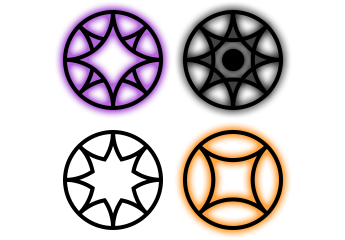
This much of the story has remained constant since the beginning. In the first version, though, the protagonist had a different name and was not a shadeweaver but a sorcerer, one who casts spells by drawing magic circles inscribed with particular symbols depending on the desired effect. Sorcerers were identified by their golden- or amber-colored eyes. There were also wizards, whose eyes were blue, and magicians, whose eyes were green. Wizards had nearly limitless power and could move mountains at will. Magicians had extremely powerful talents, but their abilities were constrained to one single skill.

Shadecraft has changed all this. It is the study of the natural energies of the world, broken down into eight color-coded categories: four for the material aspects of the universe, four for the abstract. One who weaves the energies of these eight Shades into patterns to work wonders is called a shadeweaver. They view their work as art or science, and do not appreciate having the word “magic” attributed to it by common folk.

I first began writing this story when I was fourteen. Between actual drafts (that would eventually get scrapped before completion), I dreamed up elements of the world, details to lend it more realism, many of which I suspect won’t get used in this book. A book only needs enough detail for the reader to have the illusion of being able to see interesting things in the distance as they follow the path of the characters, like a tunnel painted with elaborate scenes depicting what’s going on beyond, or what has happened before. I don’t necessarily need to come up with a culture for a people never seen in the book, their homeland never visited by the characters. It’s been almost fourteen years since the start of this, though, and I think I’ve done a bit of that, some of it as an excuse to procrastinate and delay writing the actual narrative.

My goal with this is to write an interesting story set in a world with a rich history, a diverse span of cultures and peoples, and a system of magic that doesn’t involve characters pulling instant solutions out of their hats by doing things the reader thinks them incapable of. It’s an adventure, the characters will struggle and face danger, possibly death or dismemberment. It’s also the story of a young man trying to discover who he is as he enters the world for the first time.

Two books, one year

I was able to get about half of a chapter done last week. I set myself up in a Second Cup downtown, ordered a small chai latte, and plunked down in a chair near a fireplace display. This was another of those writing sessions where I discovered things as I went along, reasons why things work, explanations, etc. I also wrote a major contradiction, but staying true to NaNo rules, I ignored it and told myself it will get fixed in editing. Also, I didn’t want to cross out a whole paragraph of text. On a computer, it’s nice to pretend it never existed, it stays pretty. Here, every mistake shows up as a bar of black ink, or a furious scrawl.

I really enjoyed the latest NaNo mail I got. The beginning of it reads:

I recently met a woman named Ruth who approached me with her head hung low. “I’m sorry, but I failed NaNoWriMo,” she plaintively said. “I only wrote 10,000 words.”

I hate to hear such words. They disturb me like few others.

“You didn’t only do anything,” I replied. “You bravely signed up to make creativity a priority for a month in a busy life. You dreamed up a fantastic novel idea. You wrote thousands of words. You established creative momentum in your life. That’s huge!”

– Grant Faulkner, executive director

I wasn’t beating myself up over not having reached my goal of 50,000 words in one month, but it’s always nice to have reassurance. NaNoWriMo is such a supportive group and I don’t know that I would be working so hard to finish another book right now if I hadn’t participated last year and then again last month. Before NaNo, I was under the illusion that writer’s block was real, that the best time to write was when inspiration struck, that somehow I would find myself flooded with ideas and thousands of words would come pouring out in an afternoon.

Also, their attitude of plunging ahead and never looking back helped me realize that the elements of a rough draft do not have to be perfect. They have to lead from one scene to the next until the end of the story is found. Then the heavy machinery can be brought in to polish and clean and reshape until a scattered mess of points resembles a journey, until the characters are consistent and defined, until a pile of words resembles a book.

By the time this post goes live, I should be applying these lessons over another chai latte, continuing the journey of my characters. As I write this, I’m just shy of 20,000 words. If I continue at this pace, I’ll hit 100,000 by the end of August. I’ll have two rough drafts, or perhaps one rough draft and one second draft, all in the space of one year. It’s hard to believe I could go from having so many unfinished drafts to two complete rough drafts in such short time. All because I decided to try something different and challenge myself. (Okay, because my husband got tired of my whining and told me to do something. Thanks, dear. I really appreciate it.)

Your regularly scheduled visit to the sandbox

I have decided to update Thursdays at 17:00 Eastern Time (GMT -4:00), which means I will be writing my posts in advance and scheduling them to publish at that precise hour. It’s what I did for my last post. I never feel right announcing any sort of plan until I’ve sort of succeeded at it, that way I never end up saying, “I shall do this!” and then it doesn’t happen.

I haven’t been keeping up with Camp NaNoWriMo unfortunately. People must have been validating their word counts since yesterday, while I have accepted a defeat of sorts. It’s not a real loss, though; I’m still writing most days at my snail’s pace, taking advantage of the train ride home. I find I’m lousy with my promise to write more on the weekend, though. I have a table set up in the corner of my living room with everything I need to write, including a pair of speakers I can plug my phone into so I can put some mood music on. So far this weekend, I’ve been playing Minecraft. Building towers is fun, building worlds is better… I have to remind myself of that.

I have reached a point in my story where most of the major characters have appeared. I have made some drastic changes from previous attempts; there is a master/apprentice pair, and this time, on  whim, I’ve decided to have them be romantically involved (the apprentice is of an appropriate age, don’t worry). Elsewhere, there is a murder, and the murderer then masquerades as his victim while all assume that he (the murderer) has fled. I am embracing inspiration, letting it take me a little off course, telling myself that if these changes don’t work out, I can fix them later.

The rough draft is my sandbox, where I can play and experiment and try things I might not dare to do if I take myself too seriously. This is my hobby, and I should have fun, right?

Hacking through the wilderness

I deviated from my outline, making another chapter on the list obsolete. I tried to write it anyway, because I liked the neatness of my POV rotation: A B A C A D… etc. However, I found myself writing a chapter that didn’t have a direction, that I didn’t like writing, and that didn’t need to be there.

2014-04-18 16.18.27

So I decided to move on. “I make the rules,” is going to have to become a mantra of mine, because I seem to keep forgetting that as I write. Forcing out a chapter that will end up being crap isn’t worth losing momentum; better to set it aside and keep going. In the unlikely event that this chapter is worth salvaging in some future draft, it will be easier to do that once the bulk of the story is out.

I was essentially tying my own hands, thinking, “But… the plan! I have to work within the plan.” I’ve said from the beginning, the outline is meant to be ignored if a better idea comes along. I can work my way back to it, but I shouldn’t go hacking through the wilderness when there might be a more natural path that starts a little further out of the way. I would just get exhausted and make a mess for the sake of a straight line.

A change of scenery

I meant to post last weekend, then I felt bad for not having much of anything to say and for thinking of taking time away from my NaNo project. I am so far behind on my goal. I’m trying to berate myself just enough to light a fire under my ass, but also be realistic enough to accept that I may not get to 50k this time around. The main reason for this would be the switch from typing up my first draft to scribbling it down by hand. Typing is easier and quicker. I am infinitely more pleased with looking at nearly 70 pages of handwritten words, though.

I frequently have to remind myself to resist the temptation of spending time typing up what I’ve written so far in Scrivener. I want to save that step for when the first draft is complete, so I can give myself license to make edits as I go, to add in things that I meant to write the first time around but didn’t get to. I don’t want to do any editing at all until the first draft is done. I feel that’s a trap I’ve fallen into too many times; I get carried away with ideas I have for making the story better, and it never gets finished because I end up in an endless cycle of revising as I go. Even if I don’t meet my goal with Camp NaNo, I have to carry the lessons I learned from NaNo last autumn if I expect to get this all out.

Last week, I took a day to leave work early and set myself up in a café across the street from my apartment to write. I ordered a chai latte, streamed Songza over their free Wi-Fi, and wrote for nearly two hours. I responded to a few text messages from my husband, but other than that I didn’t touch my phone. When I began, I noticed people coming in and ordering and sitting down. By the end of it, I was so engrossed in writing that when I stopped, I wondered how the place had filled up without my noticing it. It felt good to set aside all the distractions and focus on getting the story out. I plan to make this a weekly thing, but I haven’t been back yet.

I liked being out in public and having fewer opportunities for distraction. No cats, no kitchen cupboard, no piles of DVDs/blu-rays/what-have-you. Sure, my phone could have offered up a number of diversions, but it’s surprisingly easy to ignore. I was there on a mission. Ideally, I would have written at least enough words to meet my NaNo goal for one day; I stopped just shy of 1,500. Handwriting really is so much slower for me. I’m glad I learned how nice it feels to put myself in a different setting and get to work, though.

As it’s looking more and more like I will be unable to meet the goal I set for myself, the thought I’m repeating is, “It’s okay if I don’t make 50,000 words as long as I write every day.” I am not writing everyday, though. Mostly, but there are days here and there that I skip. It seems like it’s a difficult line; I want to write often, to feel like I’m progressing in my story. I don’t want writing to feel arduous. I want it to stay fun. I want to give myself permission to read or listen to an audiobook or play a game if I don’t feel like writing any particular afternoon.

I shouldn’t ever forget that I’m the one who makes the rules here. I’ve got almost seventy pages more than I had at the beginning of the month. My book seems about a quarter full. These are positive things. I just need to keep going.

Black and white

I have not gotten off to the greatest start with Camp NaNoWriMo, though I have been able to up my writing frequency from semi-daily to daily. I think the main trouble is that where I could spend an hour to an hour and a half during NaNoWriMo typing to get my 1,667 words a day, writing longhand for that amount of time just doesn’t get me that kind of wordage. I have to step it up and devote some evening, at-home time to my writing.

This is infinitely more agreeable because I can write on a nice surface like a desk or a table instead of on my bag on my lap on the train. Also, my apartment tends not to move or curve from left to right like the train does. Big pluses, those.

I started writing Project: Destiny in a spiral-bound notebook and soon rediscovered how annoying it is having those metal wires under my hand. I wanted to buy a nice journal to write in, but didn’t want to commit to copying down what I had already written into it. Then I decided that the prologue could be in the spiral notebook (it takes several years before the story so I won’t likely reference it often) and I could continue with chapter one in a nicer book.

destiny journal

I picked this up at a bookstore downtown. The text on it reads, “Brighten up… life does not always have to be black and white.” The text repeates in French and German. I don’t know that the words are necessarily relevant to the story, though I do like the mention of “black and white” since those are two of the colors of shadecraft. The pages are lined and the spine is bound with two bookmarking ribbons, though they’re joined at the bottom for now.

As of now, I have finished chapter one at an unimpressive 1,993 words. I am getting through this draft by telling myself that things can be cleaned up and expanded upon later. NaNo last year helped me to realize that a large part of my problem with writing is my insistence on getting every little detail right the first time around. That’s what the revision process is for, though. Until the thing is bound and printed and on bookstore shelves, I have the power to change and improve it.

I’m not going to sweat it, I’m going to write a messy first draft and try to turn it into something better once the whole story is out. In this way, I’ll finally finish this project that I’ve been working on (in one form or another) for almost fourteen years.

Telling stories

I haven’t made a whole ton of progress in my writing longhand project. I have taken some days off to write in my personal journal and others to finish listening to audiobooks, which I have been using as a strategy to make my workday easier.

At my workplace, no one minds headphones, presumably so long as they don’t get in the way of actual work. I haven’t heard of anyone getting reprimanded for wearing them, and it’s rare for anyone to find me at my desk listening to nothing. Until recently, I’ve always had music on. Then I remembered those years ago when I got into running in the evenings and took audiobooks along with me to break up the monotony of the streets in my neighborhood.

Many of the tasks I perform at my job require a minimum of concentration, and most of them are repetitive and completely mindless. It’s easy to listen to a story as I copy and paste. However, to be certain that I don’t get distracted, I’ve only listened to familiar favorites so far. I’m afraid to get too engrossed in a new story, but I think it’s something I’ll have to try before too long.

I’ve listened to BBC Radio’s rendition (technically a radio play and not an audiobook) of Neil Gaiman’s Neverwhere featuring James McAvoy and Natalie Dormer; and Philip Pullman’s His Dark Materials trilogy, narrated by the author himself and a lovely cast of actors. These have been the first stories I’ve listened to that were cast with multiple actors. I am now listening to Perdido Street Station by China Miéville, and this one is a traditional audiobook with only one person doing all the storytelling.

I like when each character has its own actor lending their voice. It’s easy to fall into the flow of the story. When I’m on the way to or from work, I often close my eyes and envision the scene as it’s being described to me. I also enjoy when one person voices the entirety of the work. It requires more effort to differentiate one character from another, and I appreciate that. It also makes me think of a parent reading to a child at night (though I certainly wouldn’t pick Perdido Street Station as a tale to tell to children) and the child delighting at Mother or Father’s creativity in bringing the characters to life.

I have many more old favorites I could get through before I decide to embark on something new. I had listened to a couple books of Tad Williams’s Shadowmarch series in audio form before I ever read them, and I enjoyed that greatly. However, I was jogging then and not trying to do office work. I’ll have to give it a try to see how it goes. I can always save them for the commute if they’re too distracting for the workday.


Starting early (in notebooks)

I’ve been itching to go for a while, I had stuck a notebook in my bag with the plan of writing out Destiny longhand during the commute, taking advantage of those large chunks of time. April just wasn’t coming fast enough, though.

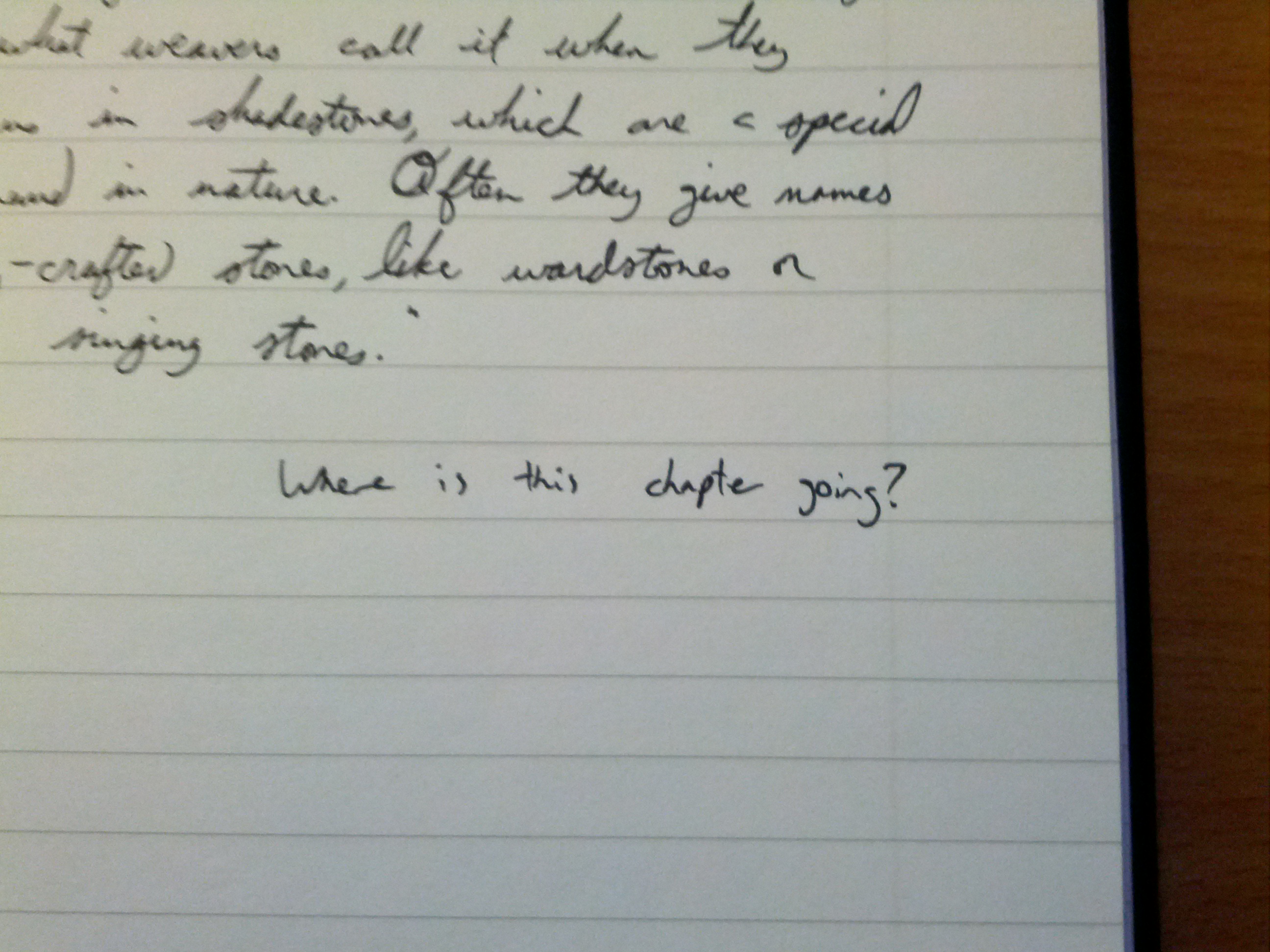
destiny notebook

Then I realized that I make the rules, and I can start before April if I like. Yesterday and the day before, I got several pages written in my little notebook. I counted the words from the first day, dismayed to find that I only write about 600 words in an hour. That’s no problem; if I can make myself use the train ride every evening to get writing done, I won’t beat myself up over the word count. It’s supposed to be a unit I use to motivate myself, not some bar I hang too high above my head.

So I’m not sure how this will play into Camp NaNoWriMo, but I’m happy as long as I’m continually making progress with my story.

I find with writing longhand, I have more time to think about the words I’m putting down.  I give myself the chance to consider other choices, to cut phrases shorter, to spend more time imagining the scene unfolding rather than just plunking down words rapidly. I’ve decided that even if I can’t make it to 50,000 words in a month, I want to write this whole thing out longhand before I put anything on the computer. Then, as I’m typing, I can make quick changes and get a sort of second draft out of it.

Another advantage is the payoff of seeing my handwriting covering a page. I enjoy typing, and tweaking fonts and whatnot, but no matter how much I customize them, the letters on a screen lack the identity my own scribble has. I love when I really get into it and write quickly, my words becoming a jumbled scrawl that only I can decipher. There is also the plus of not having to struggle with formatting in different word processors; I can indent as I like, throw in dashes, special characters, etc. I’m decent at computers, but it can break my rhythm to take a minute to figure out how best to format a particular bit of writing.

There is also the mobility of a notebook, having the entirety of the project in one place regardless of whether I have a cell signal or remaining battery. I will probably keep my outline in the cloud for when I need to consult it, but it’s nice to not have my chapter summaries nearby. I feel like I have more freedom to deviate.

One thing that remains distracting is my music choice. I really need to get off my ass and make some playlists to write to. I have a few albums that have a nice mood, but I have to gather my favorites and put them all together. I’ll work on that this weekend to be ready for the train next week.

It feels good to be writing again.

(Also, thanks to WordPress for sending weekly e-mail reminders that I haven’t been meeting my posting goal. I find them encouraging and guilt-inspiring, making me want to think of something to say and come write about it.)