The power of goals

Setting concrete goals for my writing this weekend has already helped me get off my ass. I feel this desire to one-up myself, to do better than what I said I would do. The only thing I haven’t touched so far is blog prep, because I feel like I have a lot of time left and I want to focus more on advancing my books. Yet here I am posting my second extra blog post of the week because I’m excited about goals.

goals progress

I’m especially pleased because it’s only Saturday, I haven’t even got to the extra days of this long weekend. I’m going to keep going and smash my original goals to pieces, then set more for the next arbitrary time period. Soon I’ll be setting word-count goals for Destiny (more on that later).

Now to go spend more time agonizing about Yggdrasil’s blurb. Folks, blurbs are difficult.

Time to get organized

I’ve been very good about getting work done on Yggdrasil, but I have been neglecting Destiny for the past month. I think I finally got too discouraged with my snail-like writing; the journal is lovely, but I really fly when I’m behind the keyboard and I think that’s what I want to do now. There are plenty of things I can write out longhand to fill the journals I’m so intent on collecting.

I think I need more organization in my writing life. To that end, I have purchased yet another journal to write specific goals in, so that I can make these promises to myself and either congratulate myself when I succeed or kick myself in the pants when I fail.

writing goals journal

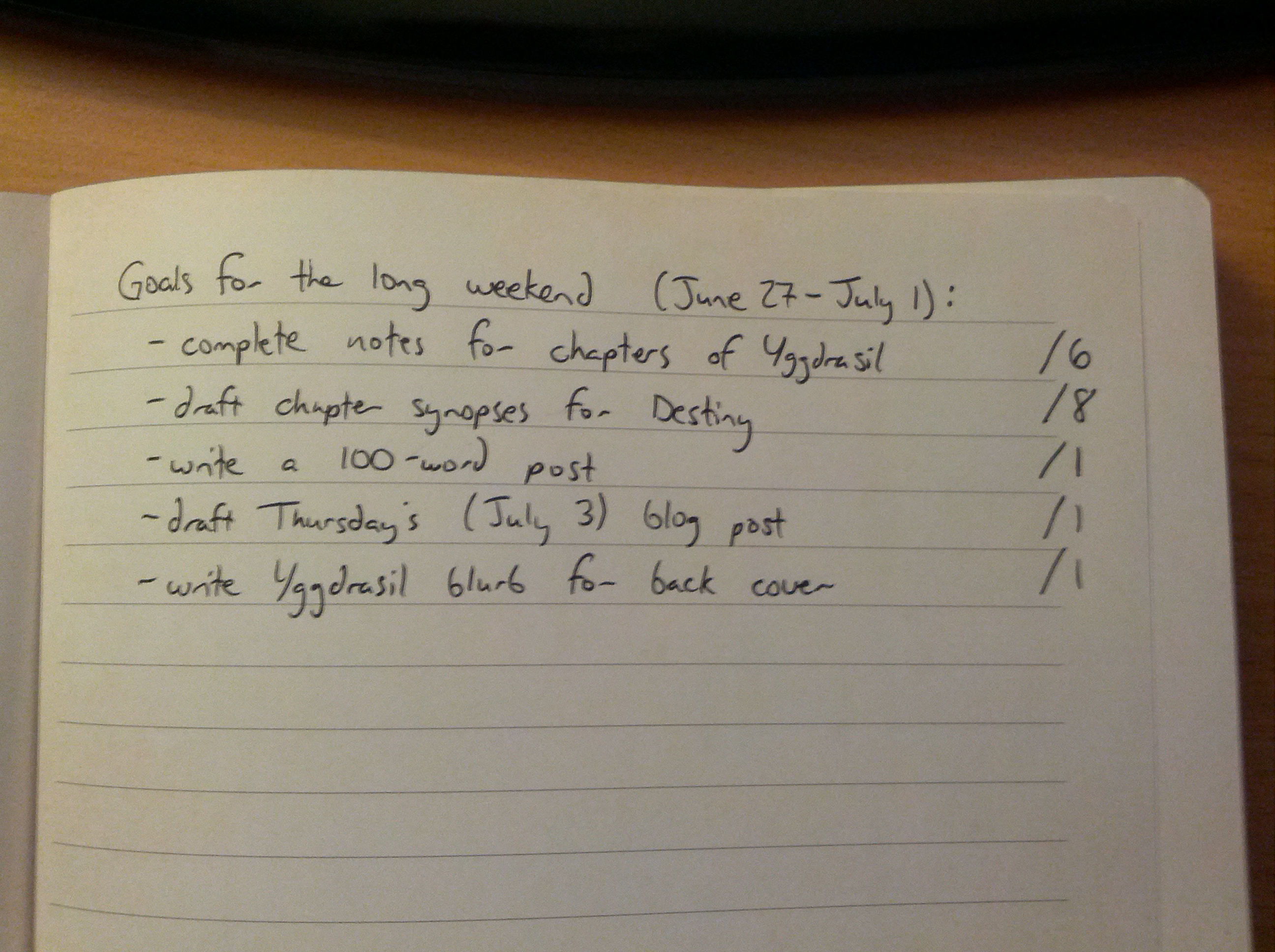
This coming weekend is a long one. With Canada Day on Tuesday, we’ve taken Monday off as well for a solid, relaxing four days off. We had a similar situation last weekend for la Saint-Jean. With this in mind, I’ve drawn up a long-ish list of goals to accomplish:

goals canada day weekend

One goal I thought about adding was “write author bio for back cover” of Yggdrasil; I keep going back and forth on whether I want one. I’ll definitely include a brief bio inside the book, but maybe a bio would go nicely on the back cover of my first book. What do you guys think?

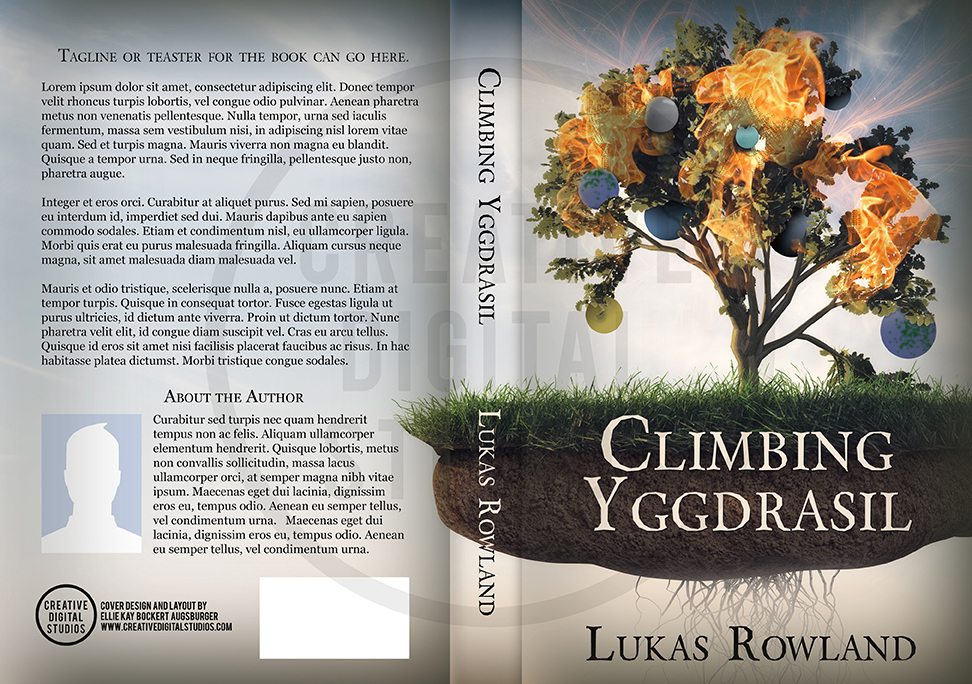
The reason for all this dilemma about whether to include a bio is that I have the final version of my cover from Ellie at Creative Digital Studios. I haven’t finalized the details for the back cover, but here’s what I’ve got:

Climbing Yggdrasil cover

I love it, and Ellie Augsburger has been a joy to work with. I’d be too embarrassed count how many questions I sent her before deciding to work with her, but she replied promptly and professionally and helped set my mind at ease about the whole process. I’m thrilled with what she came up with and her responses to my requests for changes. I look forward to working with her on future projects.

And, of course, I most eagerly look forward to seeing her cover on a physical copy of my book. I’ve promised myself I would have the second draft ready before I send off for more proofs, though.

Back to Scrivener

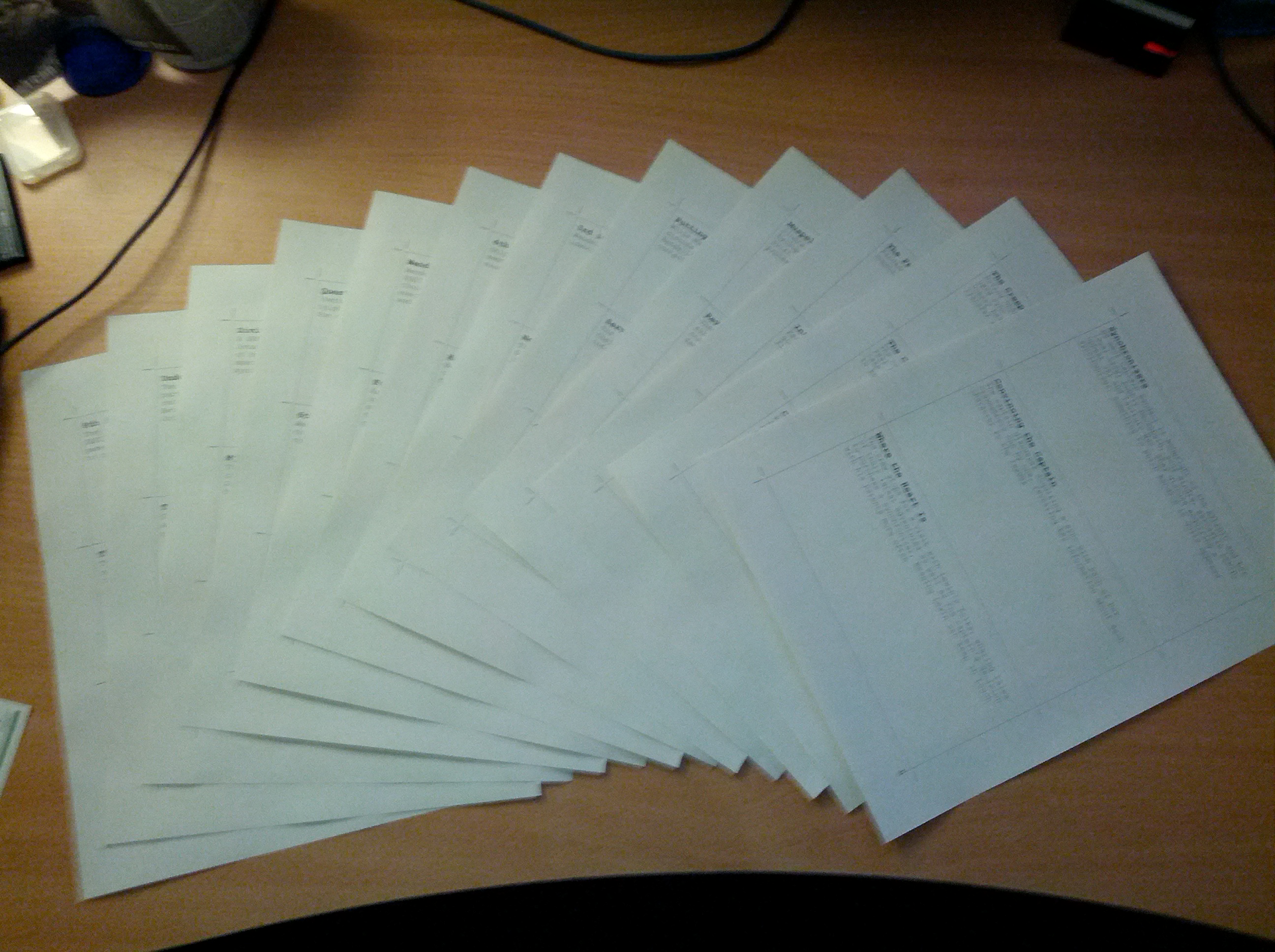
I’ve just realized that I should begin preparing for the next step of revision, the actual edits to the draft in Scrivener. As I started copying my highlights and notes from my proof to my computer, I realized that these notes are not nearly enough information for me to properly produce a second draft. To that end, I went into the notecard view of my manuscript and printed it: I got the synopsis of every chapter, three per page, on twelve pages. My entire story on a dozen sheets with plenty of room to write thoughts, justifications and feelings.

cy synopses

These notes will be vital in determining which chapters stay and which go. I want to have a solid reason for keeping every chapter, and I also want to write where new chapters need to be inserted to tie up loose ends or explain things that happen too suddenly toward the end. I’m starting to think that I might need a reread of the draft just for this, ignoring all the notes I’ve made about character inconsistencies, plot details, holes in the world, etc. This chapter justification is probably something I should have done first, so that any cut chapters won’t have already been marked up with notes for edits. I’m still making the rules up as I go, though, and the best lessons will be learned from my own mistakes.

I have reached the end of my book, with two chapters and two interludes left to mark up. I’m mostly tempted to throw them out completely and write a new ending, though. While I deliberate, I will continue transferring my notes to Scrivener at a rate of two chapters at a time (it’s very boring work) in between watching music videos on YouTube and other timesinks. I can also begin rereading the book while making my chapter notes. I can do this on my Kobo so that my more specific notes in my physical copy aren’t too distracting. Also, it’s a new Kobo and any excuse to play with it is a good one.

I got my second proof from Creative Digital Studios today (yesterday, by the time this goes live) and am absolutely thrilled. I asked for a few more changes and should have the final result by Friday, which I will definitely have to post about. This will likely light a fire under my ass in terms of getting Draft #2 ready so that I can get my hands on a physical copy with my brand-new, professionally-designed cover.

Momentum

The excitement of receiving my proofs has provided great momentum for tackling the first revision of my novel. I’ve made it through 15 chapters so far, and expect to continue at this pace until I reach the end.

There are few pages that don’t have some sort of mark on them. I’m not specifically trying to find something wrong on each page, I just want to find as much as I can. I expect that once I get to the end of the book, though, I’ll have to go through again; none of my notes so far have anything to do with pace or plot points. I’ve printed up a table of contents with enough space to write notes about each chapter, weighing the level of conflict, if the chapter is necessary to the story or to a character’s development, if the chapter serves some other purpose or should be cut entirely. These are the notes I can’t seem to fit into the margins.

I’m finding it less difficult than I expected to ignore awkward phrasing and typos, though sometimes they make me laugh or smile in the train. My favorites so far are writing “probably” when I meant “probability” and a scene that contains a “conversational silence”. Such things happen when flying at a breakneck pace through a first draft. These types of errors will be addressed at the very end, if the words make the cut. No sense getting bogged down with spelling and semantics if they’re just going to be changed anyway.

tomodachi yggdrasil

One thing my first draft lacks is physical description of the characters. Over the course of writing the first draft, I came to have a good idea of what they looked like. Since I’ve been playing Tomodachi Life on the 3DS, I decided to create each of my characters on the island as Miis. It’s very silly, but I have a graphical representation of things like hair and eye color, height, and dress, to a certain extent; as a joke, I gave Kandace a captain’s uniform and Wendell a pair of pajamas.

Tomodachi Life also lets you program the personality of each islander with five axes: slow-quick (movement), polite-direct, flat-varied (expressiveness), serious-relaxed and quirky-normal. I feel like I know my characters pretty well by now, but this could be a useful barometer for determining whether certain actions or utterances are out-of-character.

Finally, I spent last week exchanging e-mails with the Ellie Augsburger of Creative Digital Studios, who is wonderfully prompt and professional and friendly with replies to inquiries. I paid a deposit and signed a contract last weekend for a book cover design. She sent me an image today of what she’s got so far, which has got me pretty excited. I want to stare at it a bit and mull it over before I get back to her with ideas for changes. I only get two more rounds of proofs at my quoted price, I want to make them count.

Proof copies

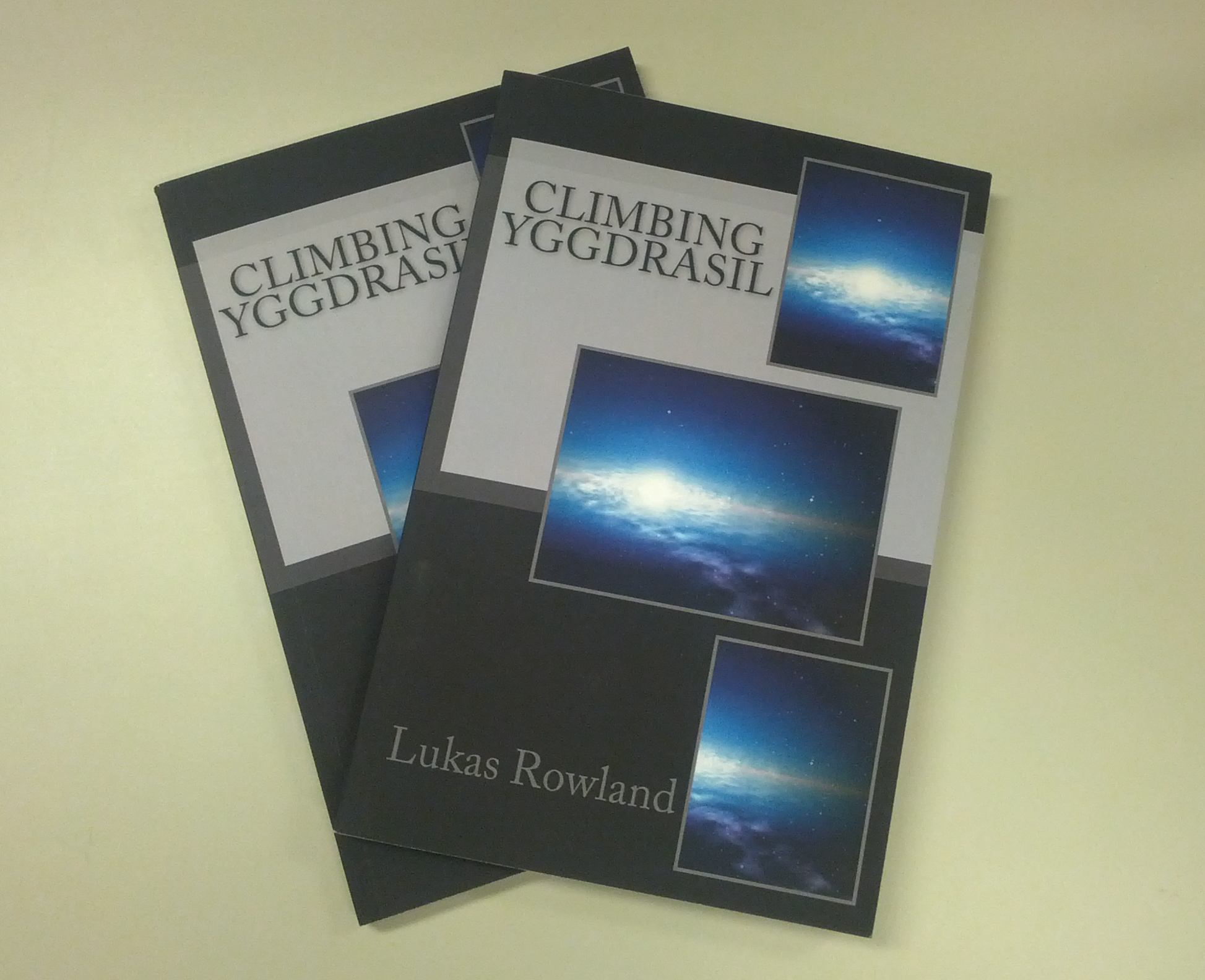
My proofs finally came in!

cy proofs

I honestly wasn’t expecting them to have the cover I’d made in the cover designer. I expected something plain with the title and “PROOF” across the diagonal in faded lettering. This is much more exciting than that.

I had them delivered to work, so naturally some coworkers saw and I have been officially outed as a writer. I still feel as though I want to establish myself before letting people around me know, as though they’ll judge me for not having proven my worth as a writer. No one so far has done that to me, though. “Oh, you’re a writer? That’s great! What do you write? When can I read it?” It’s enough to give a man the warm and fuzzies.

I have gotten in contact with Creative Digital Studios with some questions about how they work. I’m hoping to get a nice cover out of them, but there is always the issue of payment. My first inquiry got a reply with an estimate of around $300, which really isn’t that much. I kind of like the idea of getting something done soon, printing it out in color and sticking it on the wall behind my computer screen to inspire me. Hanging it in my office could be neat too.

cy proof notes

Now that I have a convenient, paperback version of my first draft, I can carry it around with me and make notes on the train. I’ve scribbled my color-code on the inside of the cover, but I’ve memorized it by now. I’ll be indicating what chapter I’ve marked up to on the sidebar, more for me than for anyone else, but it’s there if you want to look at it.

The convenience of the proof does not in any way approach the awesome feeling of having a physical book in my possession with my name on it. All it took (apart from writing the thing) was a little bit of formatting, slapping together the preliminary cover, a credit card payment and time. It has the print date at the back; I received the proofs three weeks after printing. It printed the same day I ordered it.

I’m one step closer to having a finished, polished product.

Editing at last

Now that I’ve read through Climbing Yggdrasil once, I’m ready to go back with my pen raised and mark the hell out of it. I have post-it flags and matching highlighters in four colors, so I’ve decided to focus on four elements for this next run.

Story
This is the big one. Does the scene or chapter advance the story? Is it consistent with what has gone before? Does a scene foreshadow something coming later? Does it make sense? Where I’m going to have the most work with this one is the opening chapters of the book. When I began the story, I excitedly babbled about it to a friend who asked me, “Why did you start it there? Shouldn’t you have begun earlier?” My original starting point is now chapter eight, so the beginning of the book came after I had already written several chapters, causing consistency errors.

Character
Do the characters show any development over time? Are they consistent? Are their actions convincing given their personalities? Do their actions reveal feelings and thoughts? I feel like the synchronizer and the captain are the only characters that show any change over time as of this moment, and that should change. I’m not saying every character should change by the end of the story, but they have to feel realistic and show realistic growth as they endure their trials. I also have two characters who are pretty much interchangeable in most situations, so I should to more to make them distinct from one another.

Show / Tell
Every writer knows (or should know) this one: show, don’t tell. I’ll be paying particular attention to adjectives and adverbs; they aren’t evil, but their use needs to be justified and occasional. I also want to focus on dialogue tags, trying to work adjectives or actions there into the dialogue so that what the character says reveals something about what’s going on.

The World
Is there enough detail? History? Religion? Does the story give the reader an accurate picture of the setting? Show and tell is very important here, too. It’s important not to bore the reader with pages of history and description, but rather show off the world as the characters explore the solar system, and let the reader infer certain things rather than smack them with statements.

I had originally wondered if each element would get its own reread, but I don’t think I can work that way. I think I’ll be doing multiple rereads and edits, each time trying to find more to correct until I have it as close to perfect as I can get it. I’ll make a snapshot of each version in Scrivener just in case, but I think I’ll do my best to refrain from restoring cut material.

It’s so strange to be making all this up as I go along, but until I try it a certain way, I have no idea if it works for me.

Cover art and self publishing

I have uploaded my first draft of Climbing Yggdrasil to CreateSpace, designed a cover, and ordered proof copies for scribbling in. They’ve estimated I should have them by June 2, in time for me to start a second read-through looking for problems to correct. The book is not as frighteningly bad as I expected it to be, I actually came up with some good stuff somehow! I was most concerned about the end, because I kind of rushed through the last few chapters. The chapters themselves don’t feel rushed, but it’s clear there ought to be more chapters between the ones I have to flesh certain things out so that the reader doesn’t think, “Wait, when did that happen?”

climbing yggdrasil

This generic cover won’t do for final publication; I’ve done some looking into professional cover designers and really liked what I saw over at Creative Digital Studios, but it comes down to being able to justify paying for it. There are other avenues to pursue, and I believe I’m still early enough in the editing process that I shouldn’t be rushing to have a nicer cover done just yet.

I think in the beginning of this whole adventure, back in November when I realized I would actually make it to 50,000 words and finish a book for once, I wanted to try getting it published through traditional channels. Then one of the winner goodies from NaNoWriMo was a code good for two paperback copies of my book through CreateSpace, so I started checking them out and learned how easy it is to self-publish that way. After a message to customer support, I learned that this code is not valid for proof copies; I would have to submit my book for publication in order to redeem two free copies of the final product. I don’t think I’ll be ready by the time the code expires.

The more I played with CreateSpace, the more attractive the idea of self-publishing my first novel became. This wouldn’t mean I couldn’t try a later book through a publisher; it might even help to have a self-published book floating out there (assuming it gets positive reviews; I’ll have to make sure it’s good enough to do that). I could be entirely wrong, publishers might look at a self-published author as some kind of terrible amateur who has no business trying to gain traction in the world of traditional publishing.

I just want to get my work out there for people to read, though. I’d like to have a final draft polished and ready to go up on CreateSpace by November. I should probably figure out what I’m going to do about a cover in the coming months, then.

Anyone have experience with publishing, self or otherwise? What has that been like for you?


Two books, one year

I was able to get about half of a chapter done last week. I set myself up in a Second Cup downtown, ordered a small chai latte, and plunked down in a chair near a fireplace display. This was another of those writing sessions where I discovered things as I went along, reasons why things work, explanations, etc. I also wrote a major contradiction, but staying true to NaNo rules, I ignored it and told myself it will get fixed in editing. Also, I didn’t want to cross out a whole paragraph of text. On a computer, it’s nice to pretend it never existed, it stays pretty. Here, every mistake shows up as a bar of black ink, or a furious scrawl.

I really enjoyed the latest NaNo mail I got. The beginning of it reads:

I recently met a woman named Ruth who approached me with her head hung low. “I’m sorry, but I failed NaNoWriMo,” she plaintively said. “I only wrote 10,000 words.”

I hate to hear such words. They disturb me like few others.

“You didn’t only do anything,” I replied. “You bravely signed up to make creativity a priority for a month in a busy life. You dreamed up a fantastic novel idea. You wrote thousands of words. You established creative momentum in your life. That’s huge!”

– Grant Faulkner, executive director

I wasn’t beating myself up over not having reached my goal of 50,000 words in one month, but it’s always nice to have reassurance. NaNoWriMo is such a supportive group and I don’t know that I would be working so hard to finish another book right now if I hadn’t participated last year and then again last month. Before NaNo, I was under the illusion that writer’s block was real, that the best time to write was when inspiration struck, that somehow I would find myself flooded with ideas and thousands of words would come pouring out in an afternoon.

Also, their attitude of plunging ahead and never looking back helped me realize that the elements of a rough draft do not have to be perfect. They have to lead from one scene to the next until the end of the story is found. Then the heavy machinery can be brought in to polish and clean and reshape until a scattered mess of points resembles a journey, until the characters are consistent and defined, until a pile of words resembles a book.

By the time this post goes live, I should be applying these lessons over another chai latte, continuing the journey of my characters. As I write this, I’m just shy of 20,000 words. If I continue at this pace, I’ll hit 100,000 by the end of August. I’ll have two rough drafts, or perhaps one rough draft and one second draft, all in the space of one year. It’s hard to believe I could go from having so many unfinished drafts to two complete rough drafts in such short time. All because I decided to try something different and challenge myself. (Okay, because my husband got tired of my whining and told me to do something. Thanks, dear. I really appreciate it.)
Ripping the book apart

I can’t get over the separation that’s come between me and my first draft of Climbing Yggdrasil. I was just rereading a chapter, vaguely remembering what it was like to pound it out on the keyboard, and spotting little things that annoyed me about the text. Places where I was vague instead of expansive. Opportunities to do more, mostly.

As I read aloud to my husband, certain patterns emerge, things that seem a touch repetitive that I have to question. Then when I go back and reread it silently, I take notes and decide on what reinforces instead of repeats, what patterns are acceptable. In this latest chapter, our pilot’s parents reiterate a few times that they are happy the crew of the Sylphid takes care of their boy. This seems normal for a couple of farming folk whose son goes gallivanting across the solar system for years at a time between visits. (I also counted each instance and didn’t get past three, so that doesn’t seem excessive to me.)

“Just as long as you keep my boy out of trouble,” Manda murmured.

Yet I am still a little stunned by the effect time has on writing. It’s still mine, but I feel no reluctance to tear it apart and twist it painfully into something better. I am better able to see it as a reader who demands satisfaction rather than the sensitive writer who is protective of his baby.

And it’s kind of fun to rip things apart. I’m curious to see how I’ll take criticism from my beta readers. It shouldn’t be hard, my husband has already brought up things I hadn’t thought of in the vein of, “The way you wrote it is good, but wouldn’t it make more sense this way?”

Editing

Somehow, I started editing. Actually, it came from my husband’s desire to hear my work. I read aloud to him sometimes before bed, he finds the sound of my voice relaxing. I ended up reading him the first chapter of Climbing Yggdrasil, making mental notes all the while about what did and did not work for me. It’s strange, but after just over a week of sitting there, the book feels different. I’ve managed to successfully disconnect from it.

He mentioned that one particular bit of conversations seemed unnatural, designed only to inform the reader and not actually something that two people in that world would talk about. This morning, I added the following note to my manuscript:

2014-01-06 11.53.34

This morning, I asked him about several bits of information I felt uneasy about; I go on about the solar system and various aspects of the Corporation that runs it, all the while worrying that this information is boring and redundant, as much of it gets revisited in a more active manner later in the book. I worried that I was telling instead of showing. He said he felt that it was interesting and informative, and I said I would have to think on it to see if I kept it in. Readers need an introduction to the fictional universe they’re visiting, sure, but I’d rather take them on a guided tour than hand them an informative pamphlet. I may need more opinions here.

The big thing for me, though, was showing my work to someone else. True, he’s my husband and bound to treat my work with care and respect, but I have trouble showing things like this to anyone. This was an important first step for me, as was finding problems with my manuscript without getting upset or sad. These are not depressing facts, these are opportunities for improvement.

I plan to continue reading my book to my husband and getting his feedback, taking notes on really obvious things that need to be changed, on things that I need to think about, on things that might require more opinions to give me a better feel how different readers react to them. This naturally brings me to an awkward part, asking others to read what I’ve written. I think I have less of a problem with the initial question of, “Will you read this thing that I wrote?” Now my issue is, “Yeah, it’s over 300 pages, are you sure you’re okay with that?” Is that something I need to simply get over and let people who want to read my book decide if that’s too much of a commitment for them? I’ve read that a lot of people do exchanges to make things fair, and I’m interested in looking at other writers’ work and providing feedback.