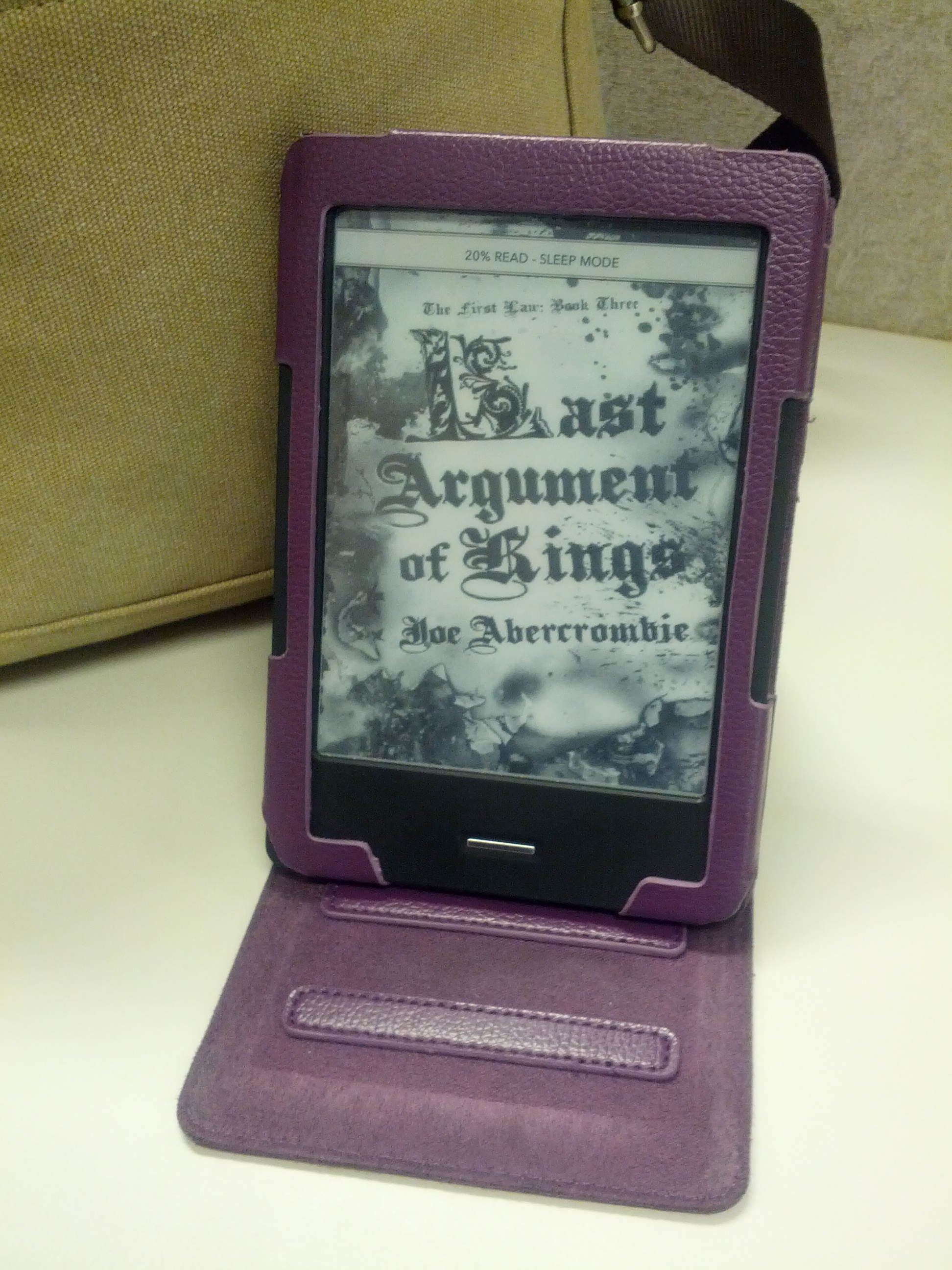
Last Argument of Kings

944076

Truly, life is the misery we endure between disappointments.

– Joe Abercrombie, Last Argument of Kings

I heartily enjoyed these books for setting many fantasy conventions on their heads, for introducing realistic characters who defy expectation without seeming to go against their natures. I love that my favorite character is a torturer and that I am still fascinated and intrigued by who I am sure is the villain.

I don’t believe this trilogy reads well if one jumps into the middle or the end. Each book is nicely encapsulated, but the whole story must be read to be appreciated. For that reason, I find it difficult to say much about the final volume without spoiling some of the surprises in the first two books.

I will say the pace of this third book does annoy me somewhat. It is split into two parts roughly down the middle; I slogged through the first 300 pages, replete with battles and death and strategies. I’m a fantasy fan who doesn’t care much for action, I prefer the magic and intrigue of it all. There is no lack of intrigue, however; our dear torturer friend has gotten himself into a bit of trouble concerning divided loyalties and blackmail.

The book more than makes up for Part I with Part II, which I tore through despite already having read it once before and having discovered the major revelations at the end. I love the ending for not being the joyous peal of “And then the world was saved and the kingdom rejoiced”. War leaves terror and ruins in its wake, and it’s fitting that the ending reflect that. The end of a war does not solve all of a kingdom’s problems either.

For me to say too much more would spoil more than is appropriate. I love the characters, from self-centered Jezal who has found himself way in over his head, to Ferro and her single-minded pursuit of vengeance. Sand dan Glokta is far and away my favorite character; a shattered ruin of a man, hobbling through each day one at a time through constant pain, ever asking why he does what he does. I suspect he only makes it through his days through heavy use of his dry sense of self-deprecating humor.
Imagining different lives

Today marks my third morning of getting up an hour earlier than usual to sit in front of my computer and catch up on internet things. While I have been enjoying what I now come to think of as “quiet time”, I think I need to shift the focus a bit. Catching up on blogs and e-mails is something I can do on the train ride to work; writing on my smartphone is something I’m less at ease with. Sure, I’ll tap out an e-mail to a friend, but blog posts or creative endeavors always feel stunted by the smaller screen, as though I’ll curtail my thoughts to fit its size. I bought a cheap tablet to see if that might work better, but found that I still couldn’t type on it as quickly as on a real keyboard.

I think I should take advantage of my quiet time to get as much use out of the keyboard as possible, saving the reading for later. I have things I want to put down here, I have updates to make to my personal journal, and I feel I am falling behind. I suppose that is better than lamenting having nothing to say.

I have started reading We Need to Talk About Kevin, a first-person fiction written as a series of letters to the narrator’s ex-husband after their son has murdered nine people at his school and been put in a juvenile detention facility. I enjoy being in this woman’s mind so far. Reading this book, I realize that I enjoy stories like these where I can fall into the details of a person’s (fictional or no) life and thoughts, especially someone markedly different from myself. I’ve already gotten through a large chunk of it in the first day, and plan to keep up the pace. I’m also interested in seeing the film adaptation afterward. I love Tilda Swinton.

It is very refreshing to get away from the sweeping vistas and endless journeys of fantasy; the intrigues and power plays, betrayals and confessions. I live there so much of the time that I forget how nice it is to visit the real world. It makes me look at people in the train and métro differently, wondering what their stories are and how they would tell them. When I was younger I used to visit coffeeshops and sit for a while, watching people and inventing stories for them. Then I would figure that my story is, of course, nothing like their reality and start imagining all over again.

Realistic fantasy, colors with substance

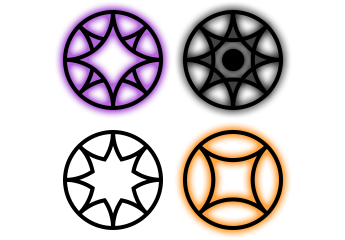
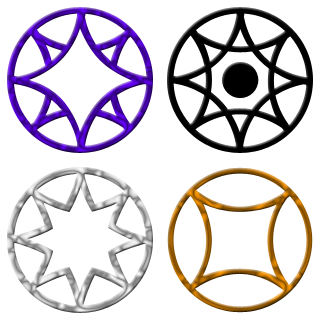
Having written on duality, especially that of creation and destruction, I’m thinking of elements in my oldest project. If you look at my blog’s header, you’ll notice the following four symbols:

fourprincipals

I have these tattooed on my inner right forearm; they represent four principal deities in Project: Destiny, and also the four domains of magic they govern. The symbols don’t derive any meaning from their shape. They are all manipulations of the orange symbol, the oldest and simplest of them.

Violet represents the duality of creation and destruction. In Project: Destiny, it also is the domain of reality and its boundaries.

Next is black, the color of chaos, secrets and lies. It also represents the future, as entropy dictates that order must descend into chaos; and thus mortality and death.

In opposition, white is the color of order, knowledge and truth; as well as the past. Black and white do not represent good and evil, however. Both lies and truth can be used to either end, as can chaos and order.

Orange is a special color in the world of Destiny. It represents many things, primarily oaths. In the world of Destiny, people are taught to never swear an oath to someone they cannot trust with their lives, as skilled “wizards” can use their power to bind the unwary to fulfill such an oath. Orange also represents language, blood ties, and humanity. This is in opposition to violet, whose power over creation and destruction can be compared to the power of gods.

Four other symbols complete this set, and these are tattooed on my left forearm: one for each of the classical elements of water, fire, earth and air. Together, these make up the eight colors of magic as portrayed in Project: Destiny.

I find it very important that magic have limits. If a character is backed up against the wall only to cast some kind of spell as a last resort, it needs to be realistic enough to be anticipated by the observant reader. If magical folk can spell their way out of any unpleasant circumstance by bending the laws of nature, they quickly become irritating. For this reason, I spend a lot of time on the way magic works in my fantasy projects. What does it cost the user? What can it do? How can it be beaten? When is it not worth the effort?

I feel like a learned a long time ago that for it to be worth the read, fantasy has to be realistic. The best-defined magic system can make all the sense in the world, and no one will give a damn if the characters aren’t interesting or don’t do anything worth reading about. Otherwise it’s all pretty colors without any substance underneath.

Duality in Brief Lives

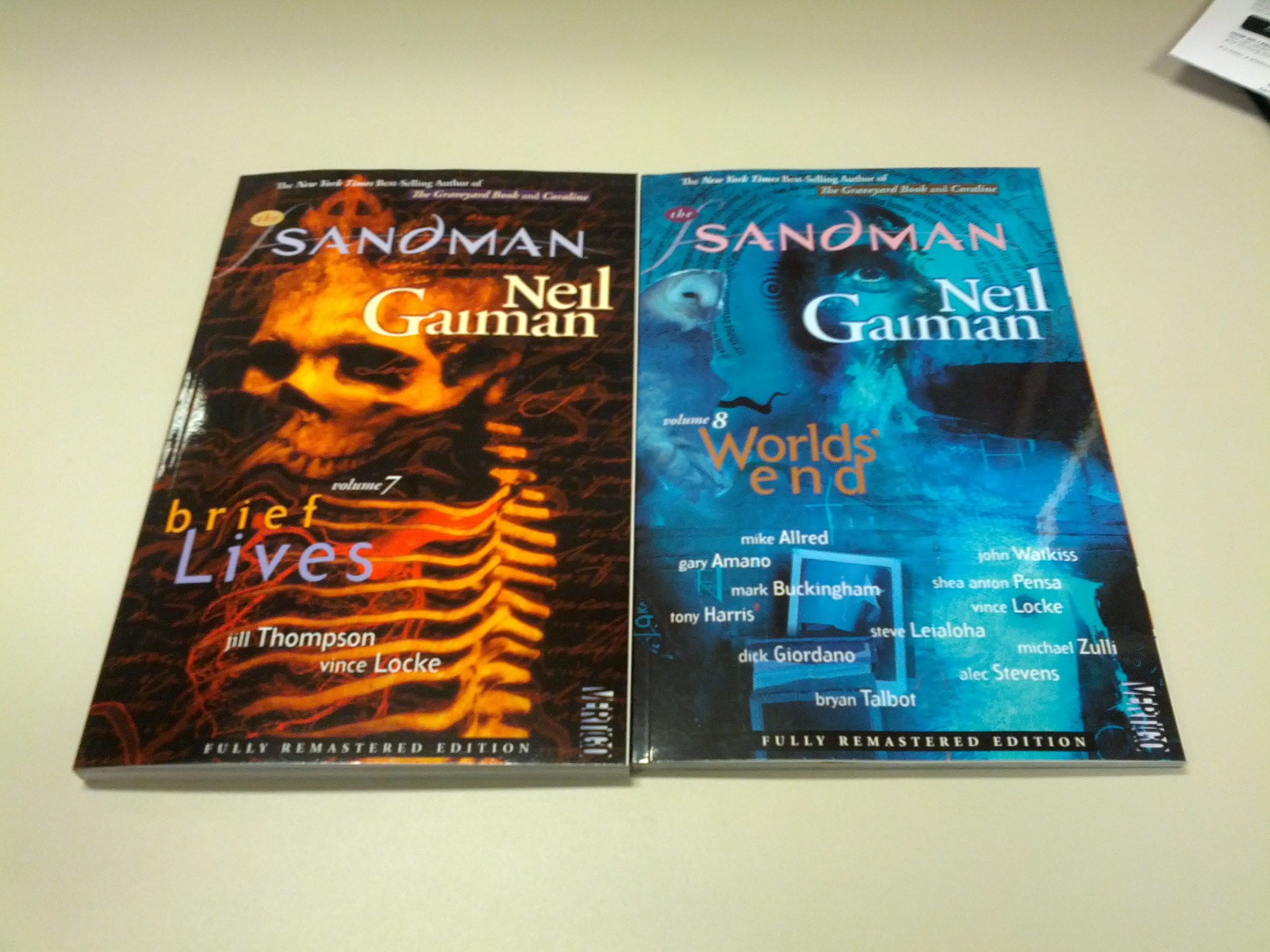
I finally finished a new volume of the Sandman. I only got as far as volume six when I was reading them in high school, and I have been slowly acquiring the trade paperbacks one volume at a time (sometimes two). This Christmas, I treated myself to volumes seven and eight.

2014-01-07 09.10.47

I finished Brief Lives last week on a train ride home from work. I thoroughly enjoyed Dream’s journey with Delirium; I had always found her interesting, but we never really got a chance to know her before this volume. We also finally learn more about Destruction, gone away on his own these past 300 years.

The concept of duality is mentioned in this volume, though it’s something I had always kind of known about the Endless. Isn’t it true of all things? Death is intrinsically connected to life, chaos to order, fate to choice. The best deities and mythological figures are like coins, opposites on either side. The two halves define one another and cannot exist on their own, like good and evil.

The volume ended with a dramatic event that had me eager to read the next, but volume eight seems to be similar to volume six in that it doesn’t advance Dream’s story. I enjoy these little vignettes, of course, but I have to restrain myself and not rush through Worlds’ End on my way to the next volume. I want to enjoy the tales instead of obsessing over what comes next for Lord Morpheus.

So far, so good. I’ll write more on Worlds’ End once I’ve finished it.

The move to ebooks

Just over two years ago, in the beginning of my last fall semester at university, I made the decision to invest in an ereader. I hadn’t been reading as much as I used to, largely due to the limited selection in the English section of my local library, and thought that by going digital I would gain access to a much greater repertoire of books. I went into Chapters to take a look at their stock and fell in love with a Kobo Touch.

My absolute favorite thing about it was the ability to browse the bookstore from my home, either on the device itself or on the computer. I quickly began to learn the advantages and limitations of the ereader; I had a few unpleasant encounters with lying in bed reading and the screen blanking to a “Please charge ereader” message. Then I learned that I should check regularly to see the battery’s charge level and plug it in before it gets too far below 50%. That usually gives me a good week or two of reading.

I am often in public transit. Back in those days, it was getting to classes and back; now, to my job in an office downtown. I would often end up standing in the bus, making it impossible to read a hardcover book and uncomfortable to do the same with a paperback. My Kobo is light and easy to read one-handed. I also enjoy being able to highlight passages I enjoy, though the precision is not the same as I get on my smartphone. I would never dare highlight anything in any of my books, and libraries generally frown on patrons doing so in books they lend out.

A feature I adored in my early days of the Kobo is a count of total hours read. I would check it from time to time, watching the number mount higher and higher, feeling that my purchase of the device was well justified. The count is no longer accurate as I’ve had to factory reset the device once or twice, and I have already established that I read much more now than ever before. I wore out my first case within a year and went looking to eBay for a cheaper alternative to the $35 ones sold in Chapters.

In the beginning, I was saddened to be leaving physical books behind. While I realize that I do not have to read exclusively on my ereader, I would much prefer to. If I am reading a series, I can ensure to have the next book loaded to the device without making my bag heavier; I can keep old favorites with me at all times, complete with memorable phrases bookmarked; I can get the definition of an unfamiliar or uncomfortable word by tapping on it whether I have cell service or not.

I still receive physical books as gifts from time to time, and they usually end up on my nightstand as before-bed reading. I have no choice but to go physical for graphic novels and the like, the Kobo Touch doesn’t display in color and is too small for comfort for graphic content. Ideally, more books would be packaged like DVDs or Blu-rays and have a code for downloading a digital copy come with them. Of course, given the way books are generally packaged, it would be all-too-easy for dishonest folk to lift the codes out of the pages without ever approaching the till. Perhaps if some kind of code were printed on the receipt, then.

From time to time, I have considered replacing my ereader with a tablet, but that doesn’t work for me for a number of reasons. My ereader’s screen looks good even in full daylight, the battery lasts way longer than that of any tablet I’ve heard of, and I read enough to justify having a separate device for that purpose (generally 1-2 hours a day, often more).

Since I started writing with Scrivener, I can also create an ePub of my work that I can read on my Kobo. It’s really motivating to see my writing on my device like a proper ebook.

Bit by bit

I finished another chapter last night, and upon rereading the summary I’d written for my outline, I noticed that I had not covered all the material I was supposed to. I look for a certain feel when I get to the end of the chapter, a nice place in the narrative to stop or change scenes. It’s the same feeling I look for when I’m reading and know I need to put my Kobo away soon; some sign that I can leave off at a good spot. Sometimes when I’m forced to stop reading in the middle of a chapter, I cannot get back to the book as soon as I’d like and I find myself having to go back a couple pages to catch up on what’s going on.

So I had three outlined chapters to write before last night and that’s still true. I think it’s time for another look into Wendell’s point of view, though, so the next chapter will likely be shorter than usual.

One of my favorite things in writing is when a scene is particularly difficult and I end up staring at my screen for long moments before writing in 50-word bursts. Somehow, bit by bit, I end up at the end of the chapter and discover that the experience wasn’t so bad. I have NaNoWriMo again to thank for this; if I hadn’t taken to heart their attitude of “keep writing, no matter what,” I may have given up and walked away in disgust each time it got difficult to figure out what to write next.

It’s work, but it’s worth it. Those 300+ pages I have sitting in a binder, waiting to be edited, are proof of that.

Presents and memories

For the past few years, my husband’s family has held a Secret Santa in addition to most everyone getting everyone else gifts anyway. The site we use asks each person to put up suggestions for the gifter; I had written a nice journal, a gift card to Indigo/Chapters, and a glass paperweight (you know, the kind with the colored bubbles inside). My gifter cheated and got me two of the three; he was supposed to stay under $20, but Christmas is the time to give too much if you can, right?

2013-12-26 10.52.15

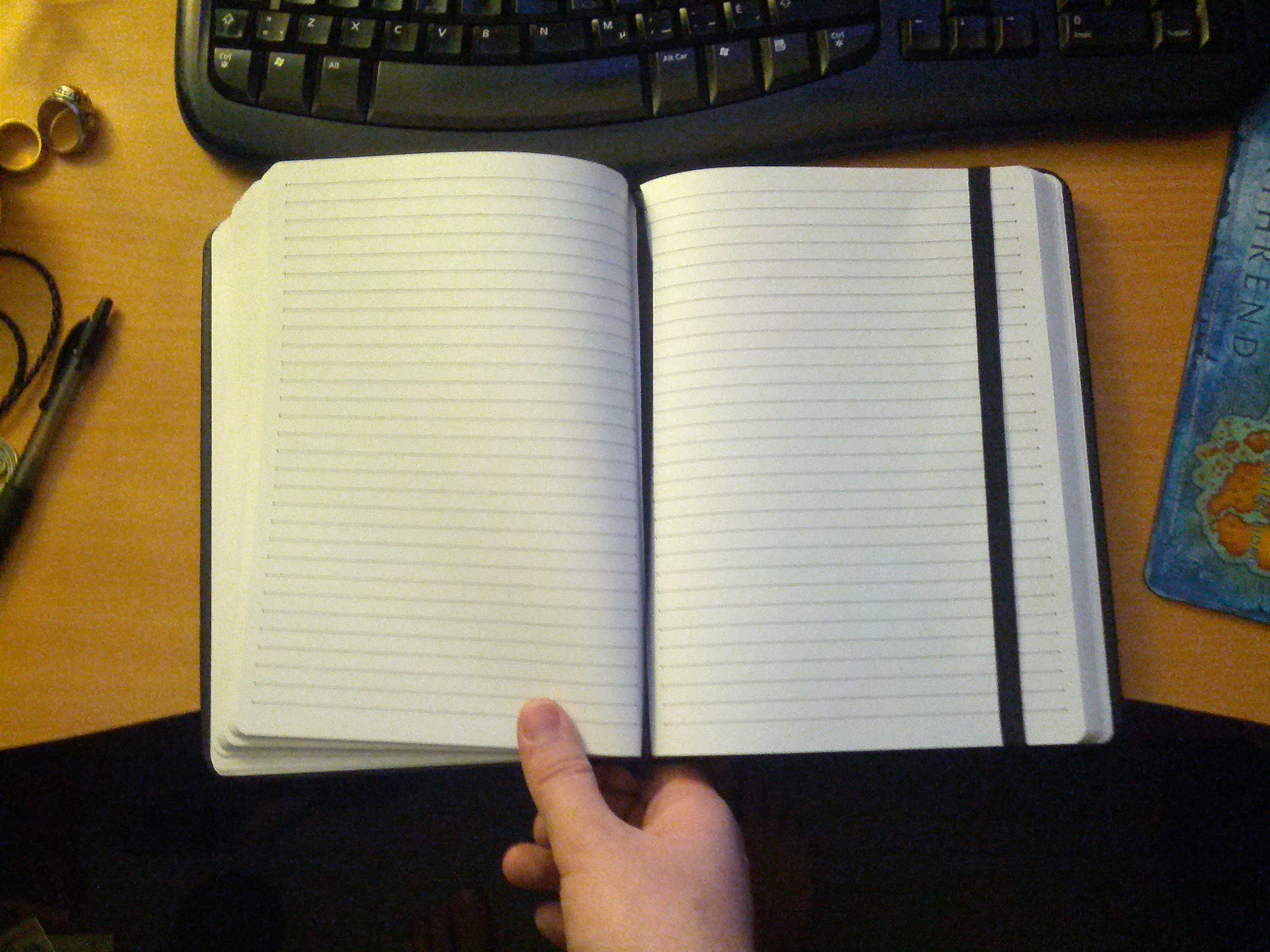
The journal is very nice indeed, bound in leather with an elastic band and ribbon bookmark. I used the gift card to cover part of an order for the next two volumes of the Sandman, which I eagerly await.

It must be said that I also received lovely gifts having nothing to do with books or writing. From my sister-in-law, I got a cutting board and tools for cheese, complete with a ceramic dish for crackers or fruits and individual little forks for guests. She also gave us a cute ornament and gift bag that our adorable two-year-old nephew put together. From my mother-in-law I received an electric mixer, something that I feel I’m missing in my house when I am forced to spend too much time whipping or whisking by hand whatever latest dessert I’m making. From my father-in-law, my husband together received lovely commemorative coins from the Royal Canadian Mint. I’m not sure which of my parents-in-law got me the chocolate orange, but Christmas just isn’t Christmas without one.

Of course, it is not the quality nor the quantity of the gifts that makes Christmas so special. One of the best parts was a picture slideshow showing old family photos. It’s always amusing and nice to see the people you know as they were when they were younger, especially with 20-year-old pictures showing old fashions in clothing and hair. It always makes me wonder if in twenty years I’ll look back on my fashion choices today and wonder what the hell I was thinking.

More adventures in the Dreaming

I finished Fables & Reflections last weekend and thought yesterday would be a prime opportunity to pick up the next volume at a bookstore downtown. Yes, the second-to-last shopping day before Christmas. Great idea. The bookstore was packed and alas, only copies of the first volume of the Sandman remained on the shelves. I left without purchasing anything, despite the many tempting journals on the ground floor.

I believe this is as far as I’ve ever gotten in the Sandman. In high school, I asked the local library to borrow the volumes from other libraries. It always took weeks before the next volume arrived, so eventually I grew discouraged and stopped. Then the summer after my senior year when I had no bills but a nice cashflow from working 20 hours a week at Subway, I didn’t think to finish the series.

Fables & Reflections was an interesting journey through the pages of history. It didn’t really advance Dream’s story at all, but it was filled with gorgeous imagery and interesting characters and scenarios. I especially enjoyed seeing all of the Endless in one place for the first time; I believe in the main narrative that I’ve yet to see Destruction.

One of my favorite things about Dream is that he’s flawed, he often lets his stupid pride get in the way of acting as he should. I relate to that, despite my mortal limitations. I also enjoy seeing him as envisioned by different artists, or by different characters with different religious views and so he fits differently into each of their pantheons. I think it’s a fine metaphor for the way each of us looks different and is something different to each of the people we interact with.

That said, Merry Christmas Eve. Happy writing and reading!

Sandman confusion

I was pretty well confused when I went to buy the next volume of the Sandman from Chapters a couple weeks back. The cover of the new, remastered version of volume six is remarkably similar to that of volume one of the previous version. See here:

2013-12-21 12.19.42

While I was certain that volume six was the next one to buy, the cover threw me for a minute and it wasn’t until I was in the train reading it that I was sure I’d bought the right book.

The First Law

I’m currently rereading the third book of The First Law trilogy, a series recommended to me by a friend, a series that I quickly fell in love with. The world is realistic and gritty, rife with violence and danger; the characters are interesting, engaging, and defy archetypal expectations; and, most importantly for me, magic makes sense and has dire consequences if misused or used too freely.

2013-12-18 16.27.19

The author, Joe Abercrombie, has decided not to provide us with a map of his world, which suits me fine. Most of what I read these days is on my Kobo, which doesn’t display maps very well; I didn’t know the true shape of George R. R. Martin’s world of Ice and Fire until I bought the poster set of maps last year. Maps are lovely, but they can be distracting while reading. I have a tendency to flip to the front flap to see exactly where people are talking about.

Because of the lack of a map, we are forced to imagine the Circle of the World and its various regions. Luckily, three of these regions can be accurately named the North, the South and the West. The books visit all three of these and presents conflicts between certain regions and the central (I believe) kingdom of the Union, a kingdom filled with self-serving and/or empty-headed gentry struggling to seize power in the midst of the king’s declining health.

I greatly enjoy the writing, there is a lot of humor (especially dark humor) in it. I find myself highlighting certain passages to share them with my husband while we’re in the métro. My favorite characters are the soldier turned torturer after an extended imprisonment in the South rendered him unfit to do much else, and the highly manipulative and secretive Magus, pulling the strings with unknown intentions.

The trilogy contains a few revelations near the end that make the books more interesting to reread, though I would give them another go if only for the world and the characters and the writing. To any fan of fantasy who enjoys stories that do not take themselves too seriously (though the tone is quite serious indeed through a lot of the tale), I highly recommend The First Law trilogy: The Blade ItselfBefore They Are Hanged, and Last Argument of Kings.

Incidentally, I found a new way to read on the train, making excellent use of my winter coat and my Kobo’s protective case:

2013-12-18 18.38.37