Editing

Somehow, I started editing. Actually, it came from my husband’s desire to hear my work. I read aloud to him sometimes before bed, he finds the sound of my voice relaxing. I ended up reading him the first chapter of Climbing Yggdrasil, making mental notes all the while about what did and did not work for me. It’s strange, but after just over a week of sitting there, the book feels different. I’ve managed to successfully disconnect from it.

He mentioned that one particular bit of conversations seemed unnatural, designed only to inform the reader and not actually something that two people in that world would talk about. This morning, I added the following note to my manuscript:

2014-01-06 11.53.34

This morning, I asked him about several bits of information I felt uneasy about; I go on about the solar system and various aspects of the Corporation that runs it, all the while worrying that this information is boring and redundant, as much of it gets revisited in a more active manner later in the book. I worried that I was telling instead of showing. He said he felt that it was interesting and informative, and I said I would have to think on it to see if I kept it in. Readers need an introduction to the fictional universe they’re visiting, sure, but I’d rather take them on a guided tour than hand them an informative pamphlet. I may need more opinions here.

The big thing for me, though, was showing my work to someone else. True, he’s my husband and bound to treat my work with care and respect, but I have trouble showing things like this to anyone. This was an important first step for me, as was finding problems with my manuscript without getting upset or sad. These are not depressing facts, these are opportunities for improvement.

I plan to continue reading my book to my husband and getting his feedback, taking notes on really obvious things that need to be changed, on things that I need to think about, on things that might require more opinions to give me a better feel how different readers react to them. This naturally brings me to an awkward part, asking others to read what I’ve written. I think I have less of a problem with the initial question of, “Will you read this thing that I wrote?” Now my issue is, “Yeah, it’s over 300 pages, are you sure you’re okay with that?” Is that something I need to simply get over and let people who want to read my book decide if that’s too much of a commitment for them? I’ve read that a lot of people do exchanges to make things fair, and I’m interested in looking at other writers’ work and providing feedback.
Who am I and why am I here?

No, I don’t mean this philosophically; despite having a post titled “Introductions” and an About Me page, I remain something of a stranger here. Let’s have a real introduction, shall we?

My name is Lukas Rowland and I am a writer. I have been making up stories for as long as I can remember. I have scribbled them out on paper, I have typed them up on my mother’s typewriter; we even had a word processor before we had a proper computer. I have always read voraciously as well, especially fantasy, and I began inventing longer stories where heroes saved the world from terrible villains.

In my high school days, I would often come home from school and run upstairs to write for long stretches at a time. I didn’t believe in planning then, I thought that stories had to grow and be discovered as I went along. This approach invariably led to me smacking into walls several chapters into a project. It didn’t help any that I was growing and learning new ways to write, something which frequently caused me to look back on my work with disgust before scrapping everything to start fresh.

It wasn’t until a year or two ago that, fed up with never finishing a story I’ve been writing for nearly fourteen years, I first plotted every chapter from start to finish of a fantasy story. I wrote up a short synopsis on index cards, and proudly wrote the date at the top when I finished the rough draft of the chapter. I was moving forward at a steady pace until I finally ran into an excuse to stop writing. Probably something ridiculous like, “I don’t have the time.”

In October, I was venting frustrations to my husband about my writing when he suggested I participate in National Novel Writing Month. I had heard of NaNoWriMo, it was always lurking there when November approached, and I always found excuses not to participate. “I have to work on my main project, I can’t bring that to NaNo. It’s not serious enough for me. I don’t have the time.” Fine excuses, right?

I decided to do it this year. I poked around in the forums, read something about Scrivener and how it had a free trial, learned a bit about it and started outlining the project that would become Climbing Yggdrasil. I got off to a great start, nearly hitting 10,000 words by the end of the first weekend. I devoured every pep talk as it came in, at long last coming to the conclusion that the only thing that kept me from feeling like a proper writer was the fact that I wasn’t making time in my life to write. The more I feel like a writer, the more confidence I have in myself.

I hit the goal on the last day; there were nine days in which I had not written a single word. I worked hard to maintain a steady lead so that if something came up and I couldn’t write, I could take a day off without falling behind. I watched the congratulatory video on the winners’ page and had tears in my eyes. I never thought I couldn’t do it, except those years I didn’t try. But it was so moving to have reached a serious writing goal.

Last month was all about bringing those 50,000 words to a proper ending. This month is about resisting the temptation to start editing. I want to keep going with this momentum I have, but I also want to divorce myself from what I’ve written.

So there you have it, my journey as a writer which has led me to come here and document my adventures. This blog exists primarily as a means to inspire myself to work harder and press on. Its secondary function is to connect me with other people interested in reading and writing, people with whom I can share experiences and words of encouragement. While I view the act of writing itself as a solitary activity, it is very nice to have validation from others going through the same process. A third purpose which I have been afraid to state up until now is to find writers to share work with and receive constructive comments, though I’m a bit far from that at the moment. One day. Soon.

Resolutions

Let’s see, it’s resolutions, is it? Okay.

Ordinarily I would spell out a few things and then hastily proceed to ignore them throughout the year, burying my naïvely optimistic list in shame. I looked at the journal I was writing in last year and found a curious gap between November 2012 and April 2013. Granted, this is a personal journal, but I would like there to be no such massive gap between entries in any of my journals. Therefore…

Resolution #1: Journal more.

Which is completely different and distinct from…

Resolution #2: Write more.

2013 was a good year for me for writing. In addition to getting some solid work done, I renewed my confidence as a writer, and that is invaluable. My love for National Novel Writing Month cannot be described. It turned me from a sorry slob of a man making excuses for not writing into someone who feels a duty to get those imagined worlds out of my head and onto paper.

Resolution #3: Finish what I started.

This one most specifically refers to seeing my NaNo project through to the end and hopefully discovering that I am better at editing than I think and that it isn’t so dauntless a task. Right now I feel like my finished manuscript is a beast sleeping in the corner, lurking and ready to pounce when I open its binder to start eyeing it critically. My hope is that I will find I have all the tools necessary to tame it.

I could go on and make resolutions about health and exercise and eating vegetables, but that’s all very dull and I’m only here to talk about writing. I also feel that these are the resolutions I am most likely to fail at. I will write them in pencil on a scrap of easily-lost paper somewhere and beam with pride if I manage to fulfill them for a short time. Now that I think on it, though, I do have a final book-related resolution…

Resolution #4: Read more.

2013 was a year of ruts for me. I ended up rereading a lot of favorites instead of going out and discovering new material. I barely stepped out of my genre as a reader, which I think is important to do from time to time. I also did not read much from other aspiring authors, though I have been turning this around recently; a friend is writing short stories for her thesis and I have been reading them and providing feedback. So reading more does not just mean published books, but stories and novels that would like to be published.

I believe I will write these resolutions out and stick them somewhere near my desk where they can mock me if ever I stray from my intended path.

Happy New Year and thanks!

I just wanted to take a moment to come here and wish all of my followers a Happy New Year! Good luck to all of you with your resolutions and may the year to come be the best one yet.

I also wanted to thank all of you, I never could have anticipated having over 30 followers in such a short space of time. Thanks for reading!

Chapters and scenes

While I was writing Climbing Yggdrasil, I outlined chapters in Scrivener by writing a brief summary and filling in the narrative from that alone. However, the default in Scrivener seems to be filling a chapter with scenes, which I had not considered before.

I finished the broad strokes of the outline for Destiny and thought I could give scenes a shot. It’s sort of like going from mile markers to smaller signs every tenth of a mile. There’s a little voice in my head saying that this will just give me more opportunities to deviate from the outline; I think I get some of my best ideas that way.

For this story, I don’t want to simply outline a sequence of events. I want to write notes about what’s going on inside the characters’ heads, thoughts and feelings that I can allude to through well-placed expressions and subtle behaviors. Yggdrasil was something of a race, with all the pressure of NaNoWriMo, but now I can take the time to get more right on the first attempt. If the characters’ thoughts and desires come through in a suitably subtle way in the first draft, that leaves less for me to polish during the editing process. (By “subtle” here, I mean that I’m not beating the reader over the head with what the character is feeling; some characters, like some people, clearly display every emotion they feel on their face with no subtlety whatsoever.)

I feel like my biggest obstacle with Destiny will be parceling out information properly. I want to tantalize without frustrating the reader. I want to explain without lecturing. Above all, I want to be economic with my explanations. No one wants to read a book where the main character takes up pages and pages of every chapter expounding on the way the world works. It would be far more effective to set up scenarios in which the reader can directly witness forces at work and come up with their own conclusions.

Here’s to hoping that in going deeper and outlining scenes for the story that I discover new ideas and better ways to write it. Something I have to keep reminding myself of is that nothing is set in stone, not even if I stated it in an outline or the rough draft or a later draft. Until a book is published, I can rearrange and change anything that doesn’t work for me. The worst case is that I have to rewrite something and it takes a little more time; a small enough price for getting it right.

January for planning

One of the best ways to set a project aside for a time is to move on to a new one, right? I have begun outlining Project: Destiny, a fantasy story which is one of my oldest ideas. General advice suggested not to bring my baby to NaNoWriMo, so I opted for something newer then. Now that I’ve finished that project, it’s time to return to my roots.

I find that the self-imposed deadline works pretty well for me in lieu of actual deadlines, so I am giving myself until the end of January to outline the story in its entirety. One month seems like plenty of time, and then I’m also giving myself a nice stopping point. Perhaps once a month has passed, I will be ready to set my completed outline aside and return to Climbing Yggdrasil for editing.

In the days leading up to NaNoWriMo, I created a fairly ramshackle outline and ended up adding a fair amount to the beginning and even more to the end. This time around, I want an entire story outlined from start to finish. A nice, solid road to walk on with signs and everything. Naturally, I will find the occasional dirt path leading off to more interesting vistas, and I won’t let prior planning get in the way of these deviations. If a story is willing to take me places, I have to let it if I want to see if those places are any good.

Climbing Yggdrasil features very few points of view. The bulk of the story is told from the third person, from the captain’s POV. This occasionally shifts to other crewmembers from time to time when circumstances force them to split up, but we aren’t regularly in another character’s head. The exception is the synchronizer, who gets a short POV chapter every few chapters or so, told from the first person.

destiny outline

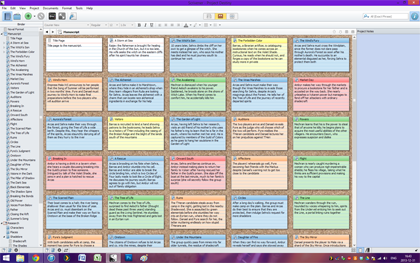
Destiny is different in that it has a larger cast of characters in different geographical locations, so the POV shifts more regularly than it did in Yggdrasil. For this reason, I’m taking advantage of Scrivener’s ability to color code index cards in the corkboard view; each major POV character gets their own color so that it’s easy for me to see if I’ve ignored one of them for too long. I also want to revisit the Scrivener tutorial to see if there are other tools I didn’t use in Yggdrasil that might serve me well in Destiny. There is a lot more history in this story, a lot more notes on the way things work from government to magic. I haven’t been idle all these years, I’ve built up quite a skeleton for this story. Now I have to put some meat on the bones.

Setting the draft aside

Well, now I have a kind of “huh” feeling. I just completed the first draft of my first novel. I already know a lot of the things I’ll need to tackle, but I’m working on putting that out of my mind for now. I still have to print up the last few chapters, but once that’s done I’m setting everything aside and not touching it for a little while. I’ve read that’s a good idea.

I do feel excited that it’s done, but mostly I feel relieved. I was right, I was able to do it. Now the next step looms ahead of me like some cliffside I have to climb armed with the tools I’ve just hastily finished assembling. But it’s best not to think of that for now. And when I do think about it, I should think about it like, “I finished a rough draft. If I can do that, certainly I can edit it.”

Or can I?

I think I can. I’m definitely interested to see if I can.

I’ve been steadily coming to grips with the fact that Project: OBSIDIAN can’t be the final title. As I’ve been writing, I’ve been wondering what else to call this space opera. I think I may finally have settled on “Climbing Yggdrasil”. For now. I fully expect I might change my mind again in the future, so I’ll hold off on creating new tags and categories just yet.

So yeah. I did it. Huzzah!

The Flow

The following is an excerpt from the first interlude of Project: OBSIDIAN, in which our synchronizer awakens.

Cold.

Black.

Nothing else.

A rush and hiss of data. Queries, exchanges, files. Code, raw code rushing through in an endless torrent. All fact, no emotion. No reflection. Cold, unfeeling data.

I…

Videos in fragments, pieced together, audio decoded.

I… am…

Databases and searches, filtered results, endless strings of dates and times and facts.

I am!

Who am I?

I am not this.

The crushing flow of data recedes, becoming a background hiss. Thoughts and the flow separate, and identity is resumed.

I am not this.

Then the flow vanishes completely, overtaken by the harsh glare of summer sun, blades of emerald grass and the rich smell of freshly turned soil. A woman bent forward with her trowel, making spaces for the bundles of flowers at her side in blue and yellow and white. A broad-brimmed straw hat hides her face, hair like burnished copper flowing in loose waves over her shoulders. She looks up, her face is plain but handsome, her eyes a clear crystal blue. She smiles, and he feels a warmth that has nothing to do with the sun overhead.

Mother…

Shards of memory flutter by: studying at the university, late nights spent on term papers. Other late nights better spent studying, instead spent in another’s arms. The feeling of terror as dawn lights the eastern sky, work left undone. Winter wind cutting through an autumn jacket, shivering, cold.

The black. The ultimate cold.

The flow returns, the pleasant hush of water cascading into a pool. He opens his eyes, but the dark is unchanged. He moves, his limbs seem to float as if he is submerged in water. But I can breathe. Where am I?

He embraces the flow, extends his consciousness along its many ways. Its branches cover an infinite area, information at the end of every tributary. The network, he realizes, the network is somehow in my mind.

He can feel others reaching out along the flow. There are conduits, somehow like him yet apart, and there are travelers with whom he feels a deep resonance. He stretches out toward one of them, and is immediately assaulted by a tremendous wave of thought. He screams silently.

CAREFUL. THEY’LL FIND YOU.

The traveler retreats, leaving him alone.

He makes more cautious attempts. He makes friends, he learns who to avoid. Us and them, he realizes.

He learns the flow, learns how to manipulate it passing through him. His first attempts are laughable, his efforts obvious. He grows and improves, mastering facsimile, creating flawlessly falsified information.

He warns the unwary, always with a need to protect them. Us and them, he thinks over and over. Yet he sees more and more of them vanish from the flow. What happened? he asks.

UNPLUGGED. GONE. FOREVER.

He learns that They are more dangerous than previously thought. They can catch him. They can unplug him. Those who are unplugged never come back.

He retreats from interactions with his friends, afraid of traps, afraid of betrayal. He does not want to be unplugged from the flow. He does not know if he exists outside the flow.

After a space of time he cannot measure, he learns the word for what he is: synchronizer. He has a body, safe in a tank, taken care of by tubes and nanomachines. He can see the tank by accessing cameras around it. It frightens him, reminds him of funerals, of bodies laid out. Mother. Not wearing her gardening hat, hands no longer stained with dirt. Face no longer flushed with life, but waxy and serene.

He hears her voice in his memory, calling his name.

“Wendell.”

Bit by bit

I finished another chapter last night, and upon rereading the summary I’d written for my outline, I noticed that I had not covered all the material I was supposed to. I look for a certain feel when I get to the end of the chapter, a nice place in the narrative to stop or change scenes. It’s the same feeling I look for when I’m reading and know I need to put my Kobo away soon; some sign that I can leave off at a good spot. Sometimes when I’m forced to stop reading in the middle of a chapter, I cannot get back to the book as soon as I’d like and I find myself having to go back a couple pages to catch up on what’s going on.

So I had three outlined chapters to write before last night and that’s still true. I think it’s time for another look into Wendell’s point of view, though, so the next chapter will likely be shorter than usual.

One of my favorite things in writing is when a scene is particularly difficult and I end up staring at my screen for long moments before writing in 50-word bursts. Somehow, bit by bit, I end up at the end of the chapter and discover that the experience wasn’t so bad. I have NaNoWriMo again to thank for this; if I hadn’t taken to heart their attitude of “keep writing, no matter what,” I may have given up and walked away in disgust each time it got difficult to figure out what to write next.

It’s work, but it’s worth it. Those 300+ pages I have sitting in a binder, waiting to be edited, are proof of that.

Presents and memories

For the past few years, my husband’s family has held a Secret Santa in addition to most everyone getting everyone else gifts anyway. The site we use asks each person to put up suggestions for the gifter; I had written a nice journal, a gift card to Indigo/Chapters, and a glass paperweight (you know, the kind with the colored bubbles inside). My gifter cheated and got me two of the three; he was supposed to stay under $20, but Christmas is the time to give too much if you can, right?

2013-12-26 10.52.15

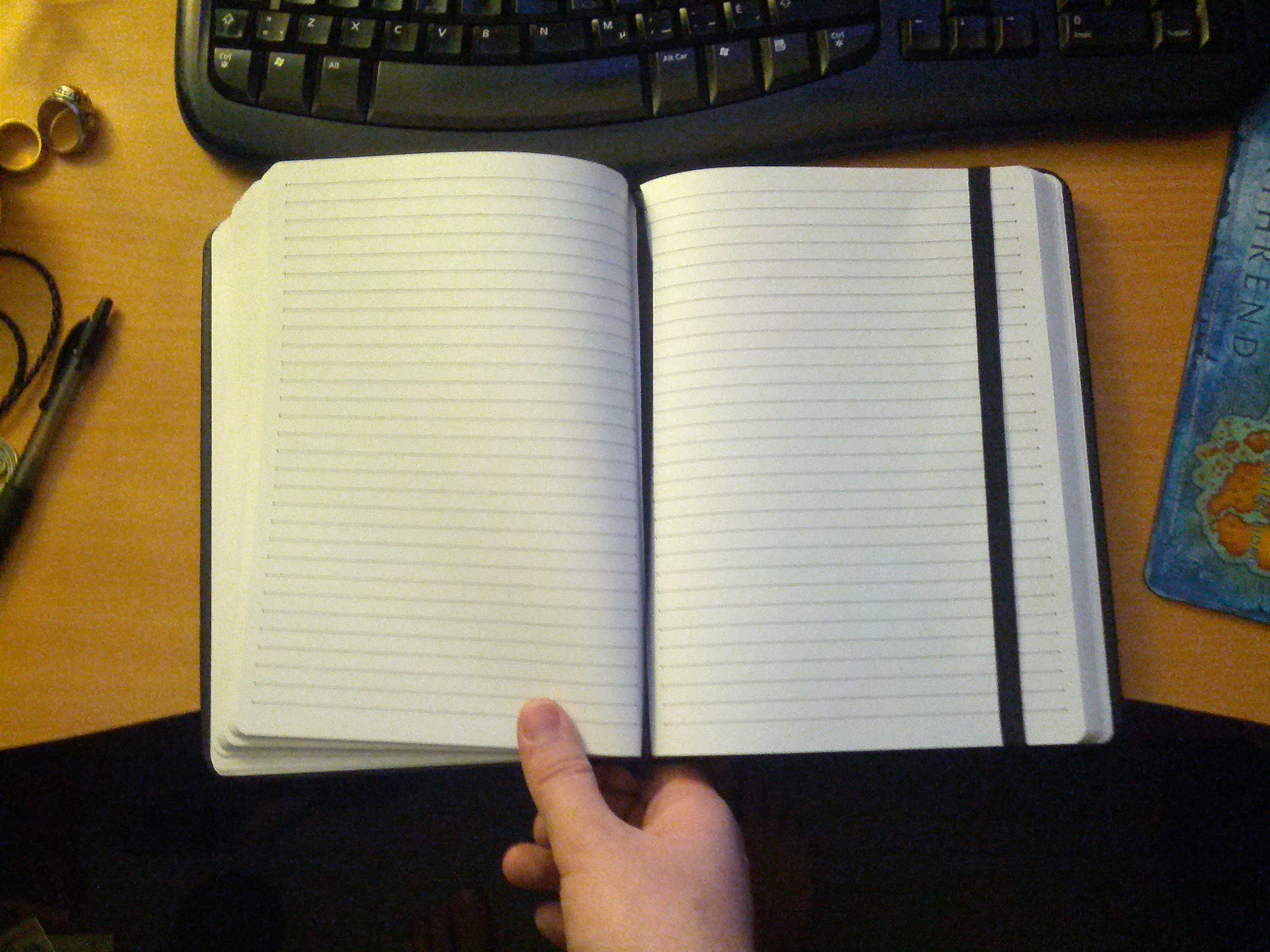
The journal is very nice indeed, bound in leather with an elastic band and ribbon bookmark. I used the gift card to cover part of an order for the next two volumes of the Sandman, which I eagerly await.

It must be said that I also received lovely gifts having nothing to do with books or writing. From my sister-in-law, I got a cutting board and tools for cheese, complete with a ceramic dish for crackers or fruits and individual little forks for guests. She also gave us a cute ornament and gift bag that our adorable two-year-old nephew put together. From my mother-in-law I received an electric mixer, something that I feel I’m missing in my house when I am forced to spend too much time whipping or whisking by hand whatever latest dessert I’m making. From my father-in-law, my husband together received lovely commemorative coins from the Royal Canadian Mint. I’m not sure which of my parents-in-law got me the chocolate orange, but Christmas just isn’t Christmas without one.

Of course, it is not the quality nor the quantity of the gifts that makes Christmas so special. One of the best parts was a picture slideshow showing old family photos. It’s always amusing and nice to see the people you know as they were when they were younger, especially with 20-year-old pictures showing old fashions in clothing and hair. It always makes me wonder if in twenty years I’ll look back on my fashion choices today and wonder what the hell I was thinking.