Worlds’ End

worldsend

Is there any person in the world who does not dream? Who does not contain within them worlds unimagined?

– Neil Gaiman, Worlds’ End

Another volume consisting of several stories, this one takes place in a tavern at the end of the worlds where several folk have been stranded thanks to a reality storm. It is their wish to share their tales until such a time as they can return to the worlds from whence they came. We have a story of a boy upon a ship at sea, a tale of an alternate United States in which a boy name Prez becomes president, and a tale of a city concerned with proper treatment of the dead and the rituals surrounding death, among others.

This volume ends similarly to the previous one; we know that something momentous is occurring, but we know not what. As one of our human characters gets a glimpse of Death, he thinks the following:

I think I fell in love with her, a little bit. Isn’t that dumb? But it was like I knew her. Like she was my oldest, dearest friend. The kind of person you can tell anything to, no matter how bad, and they’ll still love you, because they know you. I wanted to go with her. I wanted her to notice me. And then she stopped walking. Under the moon, she stopped. And looked at us. She looked at me. Maybe she was trying to tell me something; I don’t know. She probably didn’t even know I was there. But I’ll always love her. All my life.

– Neil Gaiman, Worlds’ End

I am eager to procure the final two volumes and learn what is to become of Dream and the rest of the Endless.

Last Argument of Kings

944076

Truly, life is the misery we endure between disappointments.

– Joe Abercrombie, Last Argument of Kings

I heartily enjoyed these books for setting many fantasy conventions on their heads, for introducing realistic characters who defy expectation without seeming to go against their natures. I love that my favorite character is a torturer and that I am still fascinated and intrigued by who I am sure is the villain.

I don’t believe this trilogy reads well if one jumps into the middle or the end. Each book is nicely encapsulated, but the whole story must be read to be appreciated. For that reason, I find it difficult to say much about the final volume without spoiling some of the surprises in the first two books.

I will say the pace of this third book does annoy me somewhat. It is split into two parts roughly down the middle; I slogged through the first 300 pages, replete with battles and death and strategies. I’m a fantasy fan who doesn’t care much for action, I prefer the magic and intrigue of it all. There is no lack of intrigue, however; our dear torturer friend has gotten himself into a bit of trouble concerning divided loyalties and blackmail.

The book more than makes up for Part I with Part II, which I tore through despite already having read it once before and having discovered the major revelations at the end. I love the ending for not being the joyous peal of “And then the world was saved and the kingdom rejoiced”. War leaves terror and ruins in its wake, and it’s fitting that the ending reflect that. The end of a war does not solve all of a kingdom’s problems either.

For me to say too much more would spoil more than is appropriate. I love the characters, from self-centered Jezal who has found himself way in over his head, to Ferro and her single-minded pursuit of vengeance. Sand dan Glokta is far and away my favorite character; a shattered ruin of a man, hobbling through each day one at a time through constant pain, ever asking why he does what he does. I suspect he only makes it through his days through heavy use of his dry sense of self-deprecating humor.

The Liebster Awards

Alexandra Needham has nominated me for a Liebster Award. I do appreciate the intent, but the chain-letter style of it makes me reminisce about why I left Facebook. However, I enjoy reading Alexandra’s blog and I liked the questions she posed as part of the nomination process, so here are my answers:

  1. What was your first pet? A black cat that I named, interestingly enough, Blacky. When he got run over, a few weeks later a dog of similar coloring, down to a white spot on one paw, showed up on our front step. We named him Blacky too.
  2. What is your ideal job? Writing, at home and in my pajamas, getting up at whatever hour (before noon) I please.
  3. Are there enough hours in the day? Absolutely not. If I could forego sleeping to make use of those nighttime hours, I would.
  4. What is the most obscure book you own? Why do you have it? I don’t know that I have any obscure books. My absolute favorite book, however, is Sabriel by Garth Nix. Come to think of it, I have a copy in French too. Does that count as obscure?
  5. What would you like to be able to see from your window? A nice garden, perhaps with a tree. Ideally, with a pond.
  6. Where was your best holiday or day out? It was a couple of days, actually. On my first visit to Québec, my husband took me on the train to Montréal, where I walked around in wonder at the shiny buildings and all of the strangeness of the city. We spent the night in a hotel, we shopped in underground malls, it was all so new and sparkly. I know the city a bit better now, but I still catch glimpses of how it looked that first time.
  7. Toilet paper, over or under? Under. It seems neater somehow. And perhaps it’s more difficult for the cats to unroll.
  8. What is the one thing you can’t get through the day without? My iPod. I must have music for the commute, or for walking, or whenever I am alone. I would be uncomfortable if I couldn’t read, or call or text people, but my iPod is my one must-have item.
  9. Describe your mug/teacup. I have many, but the one I currently use at work bears a pixelated heart that turns red when hot and fades to black as I empty it.
  10. What is the air-speed velocity of an unladen swallow? I could Google this to figure out what the end of the joke was, but I’d rather just admit that I’ve forgotten. Though I did watch the Holy Grail incessantly when I was younger.

Imagining different lives

Today marks my third morning of getting up an hour earlier than usual to sit in front of my computer and catch up on internet things. While I have been enjoying what I now come to think of as “quiet time”, I think I need to shift the focus a bit. Catching up on blogs and e-mails is something I can do on the train ride to work; writing on my smartphone is something I’m less at ease with. Sure, I’ll tap out an e-mail to a friend, but blog posts or creative endeavors always feel stunted by the smaller screen, as though I’ll curtail my thoughts to fit its size. I bought a cheap tablet to see if that might work better, but found that I still couldn’t type on it as quickly as on a real keyboard.

I think I should take advantage of my quiet time to get as much use out of the keyboard as possible, saving the reading for later. I have things I want to put down here, I have updates to make to my personal journal, and I feel I am falling behind. I suppose that is better than lamenting having nothing to say.

I have started reading We Need to Talk About Kevin, a first-person fiction written as a series of letters to the narrator’s ex-husband after their son has murdered nine people at his school and been put in a juvenile detention facility. I enjoy being in this woman’s mind so far. Reading this book, I realize that I enjoy stories like these where I can fall into the details of a person’s (fictional or no) life and thoughts, especially someone markedly different from myself. I’ve already gotten through a large chunk of it in the first day, and plan to keep up the pace. I’m also interested in seeing the film adaptation afterward. I love Tilda Swinton.

It is very refreshing to get away from the sweeping vistas and endless journeys of fantasy; the intrigues and power plays, betrayals and confessions. I live there so much of the time that I forget how nice it is to visit the real world. It makes me look at people in the train and métro differently, wondering what their stories are and how they would tell them. When I was younger I used to visit coffeeshops and sit for a while, watching people and inventing stories for them. Then I would figure that my story is, of course, nothing like their reality and start imagining all over again.

Realistic fantasy, colors with substance

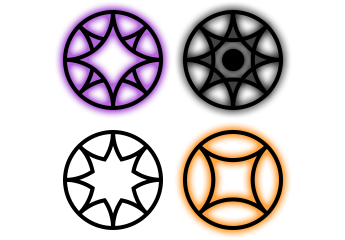
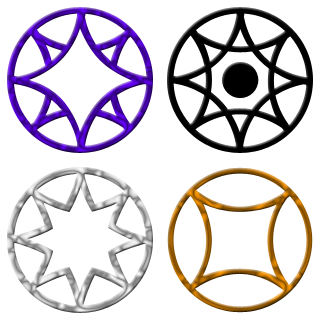
Having written on duality, especially that of creation and destruction, I’m thinking of elements in my oldest project. If you look at my blog’s header, you’ll notice the following four symbols:

fourprincipals

I have these tattooed on my inner right forearm; they represent four principal deities in Project: Destiny, and also the four domains of magic they govern. The symbols don’t derive any meaning from their shape. They are all manipulations of the orange symbol, the oldest and simplest of them.

Violet represents the duality of creation and destruction. In Project: Destiny, it also is the domain of reality and its boundaries.

Next is black, the color of chaos, secrets and lies. It also represents the future, as entropy dictates that order must descend into chaos; and thus mortality and death.

In opposition, white is the color of order, knowledge and truth; as well as the past. Black and white do not represent good and evil, however. Both lies and truth can be used to either end, as can chaos and order.

Orange is a special color in the world of Destiny. It represents many things, primarily oaths. In the world of Destiny, people are taught to never swear an oath to someone they cannot trust with their lives, as skilled “wizards” can use their power to bind the unwary to fulfill such an oath. Orange also represents language, blood ties, and humanity. This is in opposition to violet, whose power over creation and destruction can be compared to the power of gods.

Four other symbols complete this set, and these are tattooed on my left forearm: one for each of the classical elements of water, fire, earth and air. Together, these make up the eight colors of magic as portrayed in Project: Destiny.

I find it very important that magic have limits. If a character is backed up against the wall only to cast some kind of spell as a last resort, it needs to be realistic enough to be anticipated by the observant reader. If magical folk can spell their way out of any unpleasant circumstance by bending the laws of nature, they quickly become irritating. For this reason, I spend a lot of time on the way magic works in my fantasy projects. What does it cost the user? What can it do? How can it be beaten? When is it not worth the effort?

I feel like a learned a long time ago that for it to be worth the read, fantasy has to be realistic. The best-defined magic system can make all the sense in the world, and no one will give a damn if the characters aren’t interesting or don’t do anything worth reading about. Otherwise it’s all pretty colors without any substance underneath.

Duality in Brief Lives

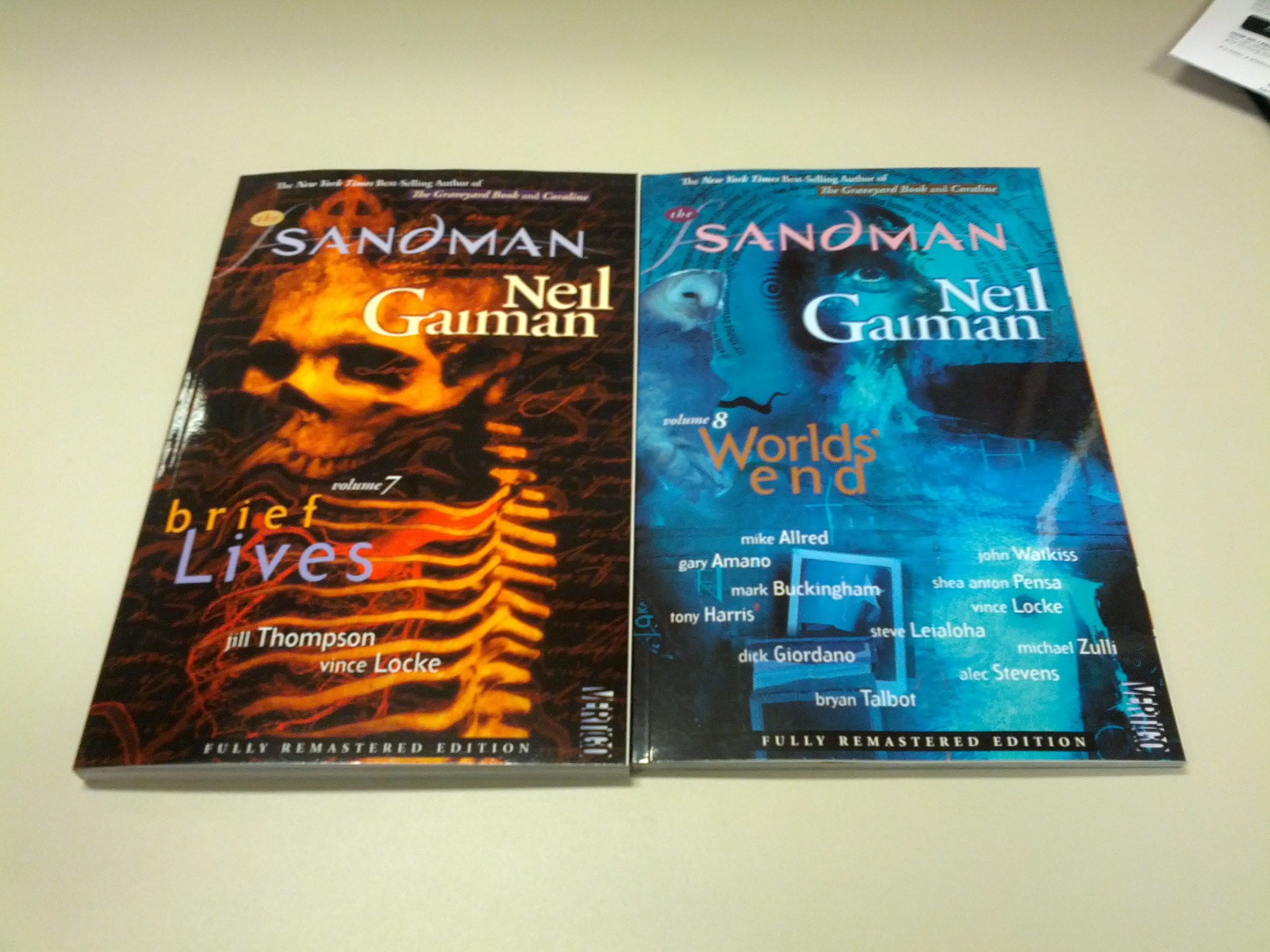
I finally finished a new volume of the Sandman. I only got as far as volume six when I was reading them in high school, and I have been slowly acquiring the trade paperbacks one volume at a time (sometimes two). This Christmas, I treated myself to volumes seven and eight.

2014-01-07 09.10.47

I finished Brief Lives last week on a train ride home from work. I thoroughly enjoyed Dream’s journey with Delirium; I had always found her interesting, but we never really got a chance to know her before this volume. We also finally learn more about Destruction, gone away on his own these past 300 years.

The concept of duality is mentioned in this volume, though it’s something I had always kind of known about the Endless. Isn’t it true of all things? Death is intrinsically connected to life, chaos to order, fate to choice. The best deities and mythological figures are like coins, opposites on either side. The two halves define one another and cannot exist on their own, like good and evil.

The volume ended with a dramatic event that had me eager to read the next, but volume eight seems to be similar to volume six in that it doesn’t advance Dream’s story. I enjoy these little vignettes, of course, but I have to restrain myself and not rush through Worlds’ End on my way to the next volume. I want to enjoy the tales instead of obsessing over what comes next for Lord Morpheus.

So far, so good. I’ll write more on Worlds’ End once I’ve finished it.

Managing my time

I had the great fortune to be on vacation for many days during the holiday season this past couple weeks. Now that I find myself in the middle of my first real week back, I notice that I am not blogging as much nor doing as much writing or editing. Curious, that.

I’ve read a lot about people who work to balance a full-time job (or school) with writing and the general sentiment seems to be that saving writing for the end of the day is a bad idea; work or school is invariably mentally and physically draining, leaving us with little left over to put on the page. Also, in the few hours I have at home before I go to sleep, I prefer to spend time with my husband instead of lock myself away to hammer at the keys for an hour or so.

I have given some thought to rising early for the sake of writing. To be honest, the idea of rising early for anything sounds unholy. Then again, I have gotten up earlier than usual and not suffered any terrible consequences; it’s actually easier to get up if I have some special reason to do so. It would be a nice, quiet (dark) time to collect thoughts and put them down. I couldn’t listen to music too loudly, but that’s a small compromise.

I can’t be on vacation all the time, sadly. I have to make the most of the time that I have.

How do you all balance life and writing?

Editing

Somehow, I started editing. Actually, it came from my husband’s desire to hear my work. I read aloud to him sometimes before bed, he finds the sound of my voice relaxing. I ended up reading him the first chapter of Climbing Yggdrasil, making mental notes all the while about what did and did not work for me. It’s strange, but after just over a week of sitting there, the book feels different. I’ve managed to successfully disconnect from it.

He mentioned that one particular bit of conversations seemed unnatural, designed only to inform the reader and not actually something that two people in that world would talk about. This morning, I added the following note to my manuscript:

2014-01-06 11.53.34

This morning, I asked him about several bits of information I felt uneasy about; I go on about the solar system and various aspects of the Corporation that runs it, all the while worrying that this information is boring and redundant, as much of it gets revisited in a more active manner later in the book. I worried that I was telling instead of showing. He said he felt that it was interesting and informative, and I said I would have to think on it to see if I kept it in. Readers need an introduction to the fictional universe they’re visiting, sure, but I’d rather take them on a guided tour than hand them an informative pamphlet. I may need more opinions here.

The big thing for me, though, was showing my work to someone else. True, he’s my husband and bound to treat my work with care and respect, but I have trouble showing things like this to anyone. This was an important first step for me, as was finding problems with my manuscript without getting upset or sad. These are not depressing facts, these are opportunities for improvement.

I plan to continue reading my book to my husband and getting his feedback, taking notes on really obvious things that need to be changed, on things that I need to think about, on things that might require more opinions to give me a better feel how different readers react to them. This naturally brings me to an awkward part, asking others to read what I’ve written. I think I have less of a problem with the initial question of, “Will you read this thing that I wrote?” Now my issue is, “Yeah, it’s over 300 pages, are you sure you’re okay with that?” Is that something I need to simply get over and let people who want to read my book decide if that’s too much of a commitment for them? I’ve read that a lot of people do exchanges to make things fair, and I’m interested in looking at other writers’ work and providing feedback.

Polishing the edges

I am constantly on the lookout for ways to make this blog better. Easier to read, more accessible, interesting, pretty, etc. So naturally, when I was poking about and found the Zero to Hero challenge, I thought, “That’s for me.” So far, I’ve re-introduced myself and added a little widget to the sidebar to give visitors a little more information without obliging them to click on my About Me page. I really appreciated the widget challenge, I don’t think I would have thought of that myself.

My goal is to fill this blog with interesting and good writing, and encircle that with an informative design that doesn’t seem too cluttered or too sparse. Despite being a denizen of the internet for most of my life, I don’t have much experience in the area of web design. Also, I have a rather unfortunately biased view of my blog.

I am hoping the coming challenges from Zero to Hero help me to improve this place. I’m also open to suggestions from readers; you guys have a different view of this place and perhaps better ideas of things you’d like to see, better ways to place the information I have in the sidebar, etc. Feel free to comment on this post, or visit the Contact Me page to let me know what you think.

Who am I and why am I here?

No, I don’t mean this philosophically; despite having a post titled “Introductions” and an About Me page, I remain something of a stranger here. Let’s have a real introduction, shall we?

My name is Lukas Rowland and I am a writer. I have been making up stories for as long as I can remember. I have scribbled them out on paper, I have typed them up on my mother’s typewriter; we even had a word processor before we had a proper computer. I have always read voraciously as well, especially fantasy, and I began inventing longer stories where heroes saved the world from terrible villains.

In my high school days, I would often come home from school and run upstairs to write for long stretches at a time. I didn’t believe in planning then, I thought that stories had to grow and be discovered as I went along. This approach invariably led to me smacking into walls several chapters into a project. It didn’t help any that I was growing and learning new ways to write, something which frequently caused me to look back on my work with disgust before scrapping everything to start fresh.

It wasn’t until a year or two ago that, fed up with never finishing a story I’ve been writing for nearly fourteen years, I first plotted every chapter from start to finish of a fantasy story. I wrote up a short synopsis on index cards, and proudly wrote the date at the top when I finished the rough draft of the chapter. I was moving forward at a steady pace until I finally ran into an excuse to stop writing. Probably something ridiculous like, “I don’t have the time.”

In October, I was venting frustrations to my husband about my writing when he suggested I participate in National Novel Writing Month. I had heard of NaNoWriMo, it was always lurking there when November approached, and I always found excuses not to participate. “I have to work on my main project, I can’t bring that to NaNo. It’s not serious enough for me. I don’t have the time.” Fine excuses, right?

I decided to do it this year. I poked around in the forums, read something about Scrivener and how it had a free trial, learned a bit about it and started outlining the project that would become Climbing Yggdrasil. I got off to a great start, nearly hitting 10,000 words by the end of the first weekend. I devoured every pep talk as it came in, at long last coming to the conclusion that the only thing that kept me from feeling like a proper writer was the fact that I wasn’t making time in my life to write. The more I feel like a writer, the more confidence I have in myself.

I hit the goal on the last day; there were nine days in which I had not written a single word. I worked hard to maintain a steady lead so that if something came up and I couldn’t write, I could take a day off without falling behind. I watched the congratulatory video on the winners’ page and had tears in my eyes. I never thought I couldn’t do it, except those years I didn’t try. But it was so moving to have reached a serious writing goal.

Last month was all about bringing those 50,000 words to a proper ending. This month is about resisting the temptation to start editing. I want to keep going with this momentum I have, but I also want to divorce myself from what I’ve written.

So there you have it, my journey as a writer which has led me to come here and document my adventures. This blog exists primarily as a means to inspire myself to work harder and press on. Its secondary function is to connect me with other people interested in reading and writing, people with whom I can share experiences and words of encouragement. While I view the act of writing itself as a solitary activity, it is very nice to have validation from others going through the same process. A third purpose which I have been afraid to state up until now is to find writers to share work with and receive constructive comments, though I’m a bit far from that at the moment. One day. Soon.